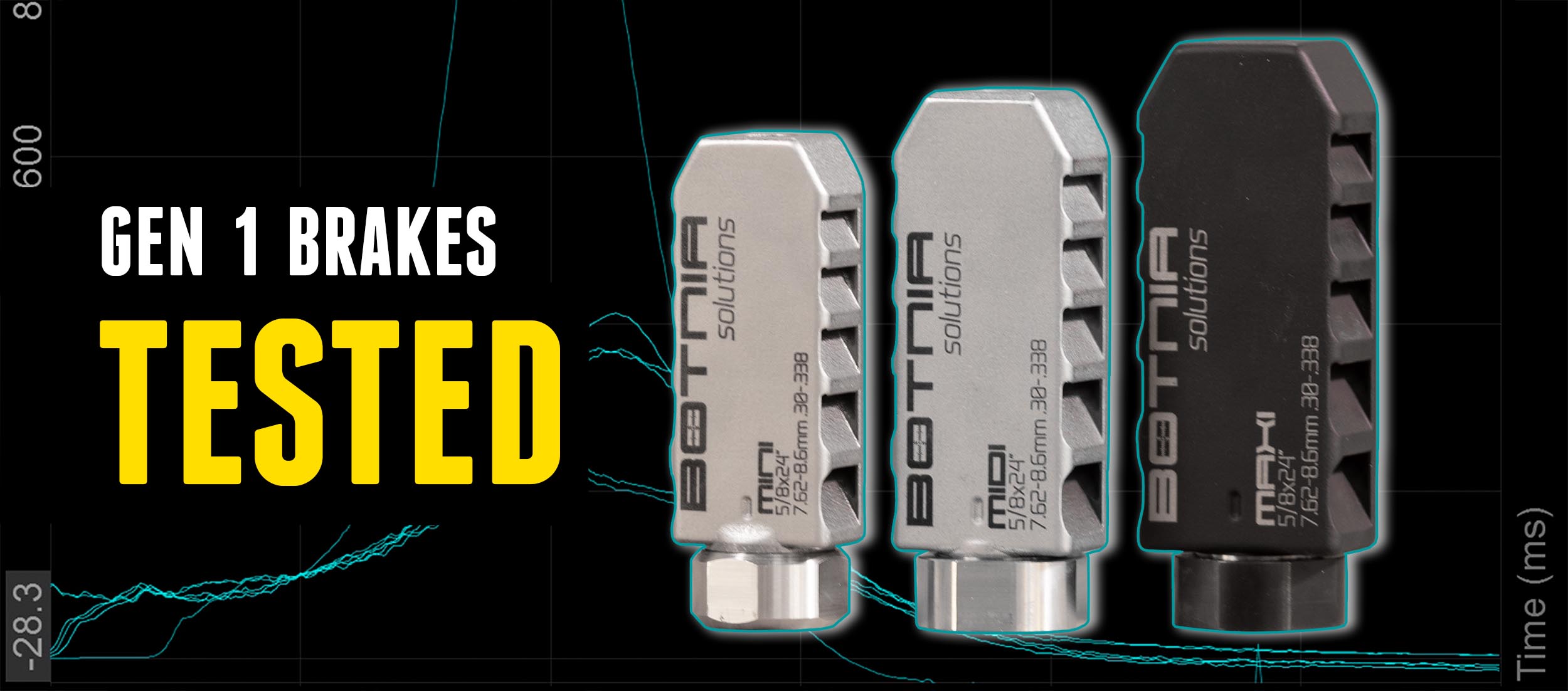
We just concluded testing of all Gen 1 muzzle brakes from Botnia Solutions and had shocking results! Read on and watch the video to see what we found!
Disclaimer
Ultimate Reloader LLC / Making with Metal Disclaimer: (by reading this article and/or watching video content you accept these terms). The content on this website (including videos, articles, ammunition reloading data, technical articles, gunsmithing and other information) is for demonstration purposes only. Do not attempt any of the processes or procedures shown or described on this website. All gunsmithing procedures should be carried out by a qualified and licensed gunsmith at their own risk. Do not attempt to repair or modify any firearms based on information on this website. Ultimate Reloader, LLC and Making With Metal can not be held liable for property or personal damage due to viewers/readers of this website performing activities, procedures, techniques, or practices described in whole or part on this website. By accepting these terms, you agree that you alone are solely responsible for your own safety and property as it pertains to activities, procedures, techniques, or practices described in whole or part on this website.
About Botnia Solutions Gen 1 Muzzle Brakes
Some time ago, Botnia Solutions reached out to us about testing their brakes. I was skeptical, as I have tested a number of brakes, and there’s a lot of stiff competition. Most brakes perform relatively equivalently.
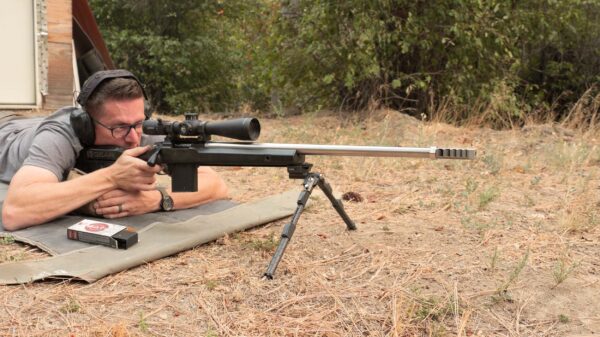
I installed a Botnia Midi brake on my custom 6.5 Creedmoor and was impressed with how little concussion it generated while providing effective recoil reduction. It was very easy to watch the shots land on paper, one after another, without leaving the target.

I fired five shots into 0.321” with Hornady factory ammunition, confirming that the brake didn’t negatively affect accuracy. Its side port design also minimized blowing dust and dirt.

Botnia founder and owner Tobias Lindgren is a dedicated PRS competitor and has represented Sweden on their national shooting team. He explained to me how he combined CAD and computational fluid dynamics to design his line of brakes. All three, the Mini, Midi, and Maxi, use a controlled gas exit with specific upward facing port geometry. All are 3D-printed, five-port brakes that hold the gas to higher pressures and when directed reduce recoil more effectively.

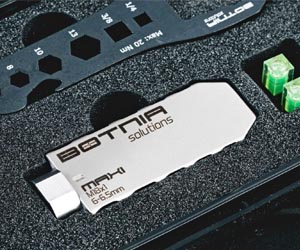
The threads are CNC machined and final reamed for optimal concentricity. They also come with a jam nut, so you do not have to worry about timing. The Midi and Maxi brakes include a tool to assist with this and all brakes come with bubble levels. These brakes are available in silver or black Cerakote.
From Botnia Solutions:
Which Muzzle Brake Should I Choose?
We offer three brake sizes — Mini, Midi, and Maxi — each built on the same high-performance design. The right choice depends on your caliber, rifle weight, and how you plan to use the rifle — whether for competition, hunting, or general shooting.
✅ Quick Model Overview
All Botnia muzzle brakes are made from the same materials and follow the same high-performance design. Even our smallest model can handle magnum calibers — including .338 — but performance is optimized when choosing a size that matches the rifle’s recoil and purpose.
-
- Mini – Compact and lightweight. Designed for hunting rifles, AR platforms, and lighter setups. It can technically handle large calibers, but is best suited for smaller cartridges where weight and size are critical.
-
- Midi – A balanced, mid-size brake ideal for most match rifles and calibers in the 6mm–6.5mm class. Offers a strong combination of recoil control and compact size.
-
- Maxi – Our largest and most effective model. Designed for maximum recoil reduction and stability. Often used with heavy calibers or in PRS competition — even with small calibers — due to its weight, balance, and superior shot-to-shot control.
🧠 Shared Design Features Across All Models
All Botnia brakes — Mini, Midi, and Maxi — share the same engineering blueprint and core performance principles:
-
- Low ground-blast angles for reduced dust signature and improved shooter comfort
- Controlled gas exit design for smooth impulse and stable recoil
- Long, directional channels that produce a tight, linear gas line — instead of the wide, expanding cones seen in conventional brakes
- Upward-facing ports that apply downward force without introducing disruptive vibration or imbalance
This results in a clear, undisturbed view through the scope during recoil, allowing for better tracking and faster follow-up shots.
💡 Why PRS Shooters Often Prefer the Maxi
Although originally designed for larger calibers, the Maxi is widely used by PRS competitors even with small calibers — and for good reason:
-
- Forward weight improves rifle balance and helps reduce muzzle rise through inertial braking
- Allows some shooters to remove internal chassis weights, resulting in a lighter overall system with better control
- Dampens muzzle whip and harmonics, improving consistency
- Keeps the reticle stable and visible throughout recoil, aiding follow-through
Unlike overly aggressive brakes that introduce vertical force, Botnia brakes avoid:
-
- Jumping bipods
- Visible barrel bending (seen in slow-motion)
- Strain on scope mounts, bedding systems, and action screws
- Reticles being driven below the target
Rifles are designed to handle linear recoil forces — not vertical stresses. Our brakes work with that principle, keeping the system stable, accurate, and consistent.
🔍 Choosing the Right Brake
-
- Use the Mini if you’re building a compact or lightweight rifle and want minimal bulk.
- Choose the Midi for 6mm to 6.5mm match rifles where size and performance need to be balanced.
- Go for the Maxi if you’re using heavier calibers — or if you’re a PRS competitor looking for maximum control and rifle stability, even on smaller cartridges.
If you’re unsure, feel free to contact us with your rifle model, caliber, and thread, and we’ll be happy to help you choose the best match.
🔧 Caliber Compatibility – Botnia Muzzle Brakes
Our Gen 1 Series muzzle brakes are built around two optimized internal bore sizes to match bullet diameters safely and effectively:
✅ 5,56–7mm (223-284) Brake
-
- Supports bullet diameters up to 7mm (.284 inches)
- Internal bore: 8mm (.314)
- Can be used with 7mm bullets, make sure alignment is verified.
✅ 7.62–8.6mm (308-338) Brake
-
- Supports bullet diameters from 7.62mm (.30 cal) to 8.6mm (.338 cal)
- Internal bore: 10mm (.400)
- Can be used with smaller calibers as well, but depending on the cartridge, some performance may be reduced due to increased bore clearance. 1-4%
Additional Information
Top Performance
High-performance brakes that don’t pick up dust from the ground when prone shooting or produce considerable concussion.
Cutting edge manufacturing process, SLM 3d printed body and CNC cut threads and bore for best finish and tolerance. The SLS process gives us the option to make an unmatched reduction in recoil without sacrificing our ears and eyes. The ports are angled upward to prevent dust pickup and help reduce muzzle rise.
Why no top ports?
We opted for no top ports because it was requested by the top PRS shooters that helped develop the brake. Carbon buildup in top holes will affect zero in ways that side ports don’t. For a muzzle brake aimed at the top PRS community, this was an easy choice.
Alignment
At the same time as we cut the threads and shoulders, we also finish the bore of the brake with a reamer to acquire close to 0% runout at the muzzle.
Port design
When the gas depletes, we shrink the port size to keep the internal pressure up so we can keep redirecting and make use of fast-pressurized expanding gas.
Trying out design iterations during 2023, geometries shape and angles. I opted for a Square design because our test with round brakes shows that It can’t redirect gas well enough.
Too much gas goes toward the ceiling and floor with side ports on a cylinder-shaped brake. Creating more “eco” and “bang” for everyone in the shooting area including the user.
What’s included?
Multitool in a perfect size for a Range bag, with a little extra feature for use cases besides tightening the brake. Bit’sholder, 1/4-3/8 inch hole for torque wrench.
2 small bubble levels are included. One is to be used on the scope turret and the other on the muzzle brake to guarantee a level brake and ensure a repeatable zero when mounting the brake to the barrel. Align the brake when clamped in a barrel vise for the best experience and result.
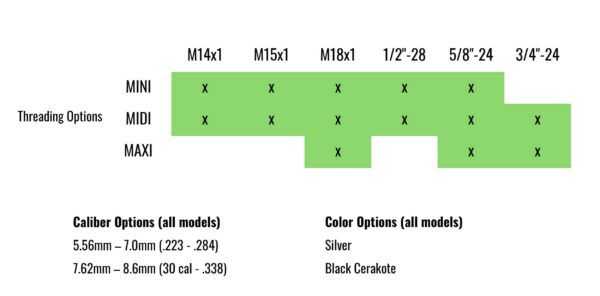
Botnia offers six different muzzle threadings: three metric and three imperial. The chart below outlines the full line of Gen 1 Botnia brakes.
Each brake comes securely-packaged in a hard case with laser cut foam.

Recoil Rig Data
It isn’t enough for us to say that these brakes tamed recoil — we used our recoil rig to collect hard data!
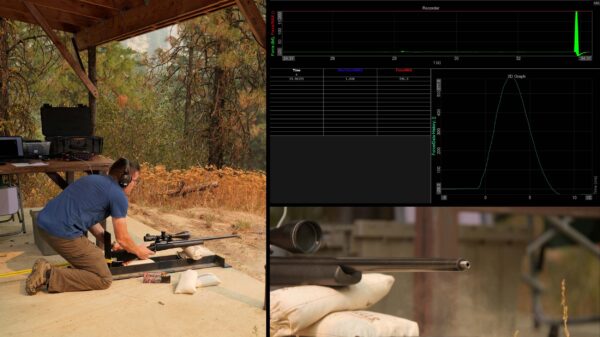
This tool is based off of a design from Cal Zant from the Precision Rifle Blog and measures forces at the buttstock at up to 200,000 samples per second. It utilizes the DEWEsoft Sirius 8-Channel DAC and a PCB Piezoelectronics load cell to capture directly comparable results. We used two different rifles in our tests — a .22-250 and a .300 PRC — and tested a variety of brakes for comparison.
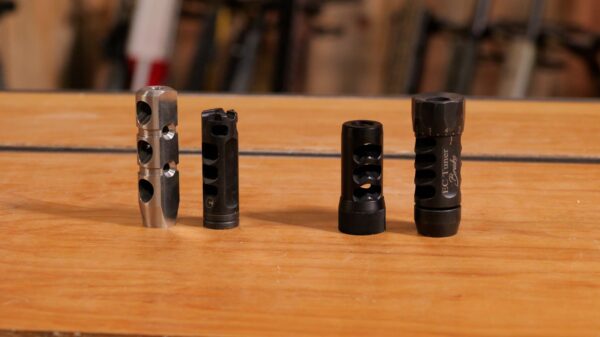
We ran five different configurations of the .22-250: bare muzzle, Botnia Mini Brake, Botnia Maxi Brake, SJC 5.56 stainless, and Ultradyne’s Mercury 5.56. We used 55 grain factory ammunition.
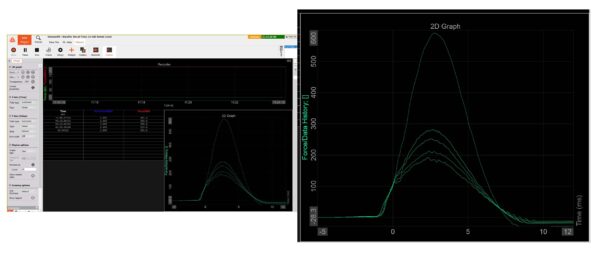
All brakes tested reduced peak force by over 50% with the Botnia Maxi and Mini coming in the top two spots with 67.4% and 64% peak force reduction respectively.

The Maxi reduced recoil another 10% more than the SJC 5.56 stainless brake, making it top of its class among the .22 caliber brakes we have tested!

For the .300 PRC, we ran bare muzzle, Botnia Mini Brake, Botnia Midi Brake, Botnia Maxi Brake, Area 419 Hellfire, and the EC Tuner Brake. We ran 225 grain match ammunition through the same Bergara HMR Wilderness rifle we used in our .300 PRC vs. .300 Win Mag test.
Firing the .300 PRC without any muzzle device was just a reminder of the cartridge’s power as it bounced around in the rig. The DEWESoftX plot clearly shows this as well as the impact of the other brakes on recoil.

Again, Botnia brakes claimed the top spots, the Midi and Maxi having the greatest and most impressive peak force reductions at 81.8% and 81.4% respectively!

The increased gas flow and pressure of the magnum cartridge makes for more drastic recoil reduction than with the .22-250.

While shooters turn to brakes for recoil reduction, it’s also important to consider concussion and weight. What brake you choose can alter the balance point of your rifle. The Maxi and Midi had very similar recoil results, so deciding between them may come down to physical weight and muzzle dampening effect.
Conclusion
I was extremely surprised and impressed by the results and how effective Botnia brakes proved, particularly with the .300 PRC.

Their premium line-up offers a range of options suitable for hunting, competition, and general shooting and they arrive extremely professionally packaged!
Get the Gear

Don’t miss out on Ultimate Reloader updates, make sure you’re subscribed!
Thanks,
Gavin Gear