
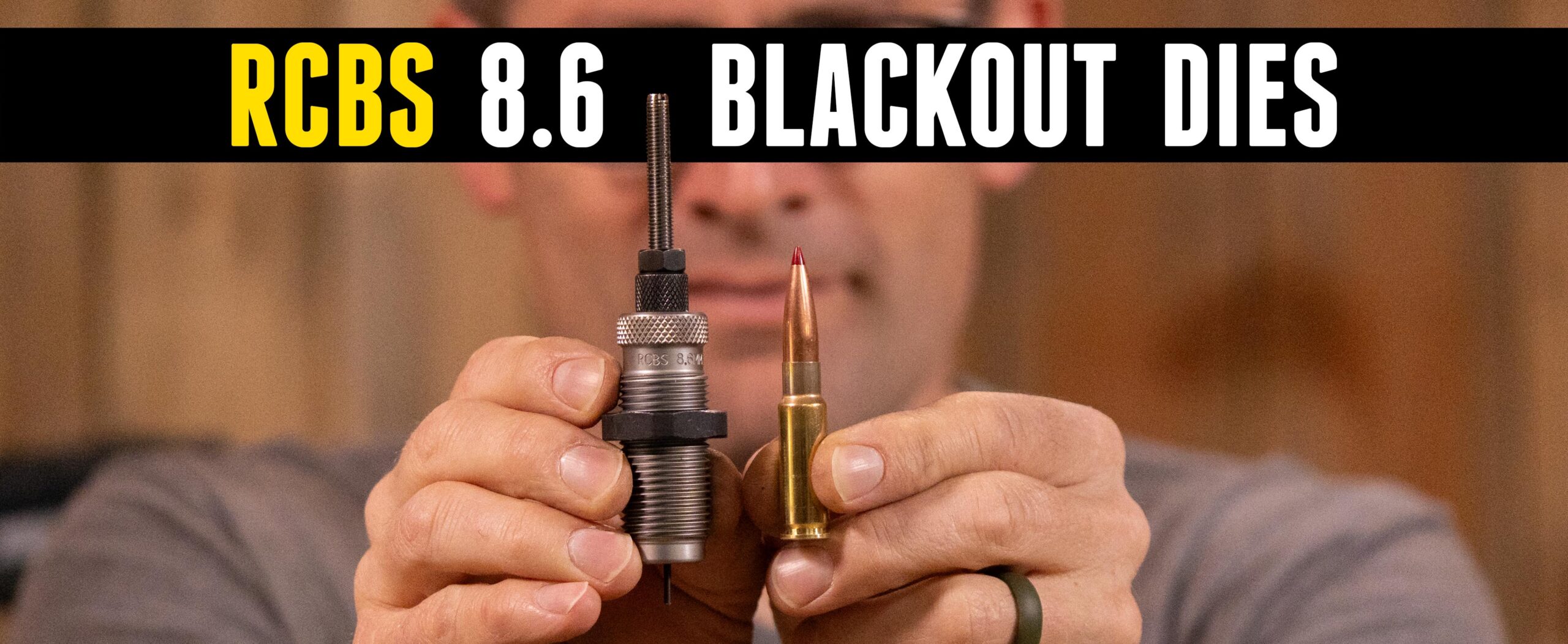
If you’re interested in loading 8.6 Blackout, this article is for you. We’ll cover bullet selection, powder selection, some very specific considerations around twist rate, and the loading process end to end. Watch or read on!
Disclaimer
Ultimate Reloader LLC / Making with Metal Disclaimer: (by reading this article and/or watching video content you accept these terms). The content on this website (including videos, articles, ammunition reloading data, technical articles, gunsmithing and other information) is for demonstration purposes only. Do not attempt any of the processes or procedures shown or described on this website. All gunsmithing procedures should be carried out by a qualified and licensed gunsmith at their own risk. Do not attempt to repair or modify any firearms based on information on this website. Ultimate Reloader, LLC and Making With Metal can not be held liable for property or personal damage due to viewers/readers of this website performing activities, procedures, techniques, or practices described in whole or part on this website. By accepting these terms, you agree that you alone are solely responsible for your own safety and property as it pertains to activities, procedures, techniques, or practices described in whole or part on this website.
Background
8.6 Blackout is a hot topic. It’s a fairly controversial cartridge, partly because of its extreme capabilities, but more so because of the twist rate and the absolutely insane RPMs you’ll see with it.
This is a continuation of part one, where we looked at a compact 8.6 Blackout bolt-action rifle and got some insane results with Alpha Munitions brass and a load the Alpha Munitions team had worked up: clean sub-MOA performance. This time, I want to elaborate on the reloading specifics and considerations.
RCBS 8.6 Blackout Dies
At SHOT Show 2025, RCBS announced 8.6 Blackout dies as part of their die set. The set includes:
- Full-length sizer with decapper
- Bullet seater with a built-in crimp function
You’ll also need your handy, trusty #3 shell holder for the 308 case rim. That’s because 8.6 Blackout is actually a shortened 6.5 Creedmoor case, with the same cartridge overall length of about 2.8 inches. It’s a really interesting cartridge, optimized for super-heavy subsonic applications with a really, really fast twist rate.
The Rifle
This rifle was commissioned by Evan Hafer, founder of Black Rifle Coffee Company, who worked with the team at Alpha Munitions on the build:
- Action: Impact 737R
- Twist rate: 1:5
- Stock: MDT HNT26 with the folder option
- Suppressor: BANISH 46
- Scope: Athlon Helos Gen 2 6-24×56
It’s a super awesome rifle: really capable, really handy, and super compact with a smaller suppressor and the folding stock.
Bolt Action vs. Semi-Auto
If you want a semi-auto, note that 8.6 Blackout is not an AR-15 cartridge. AR-15 platforms have a maximum cartridge overall length of 2.260 inches, and 8.6 Blackout is essentially 2.825 inches. Interestingly, that’s just over the AR-10 length, typically thought of as 2.800 inches.
Nonetheless, if you want a semi-auto 8.6 Blackout, your likely outcome is an AR-10. It has the magazine capacity and the 308 bolt face you’ll need, so that would be a clean way to go. I haven’t messed with 8.6 Blackout AR-10s, but if there’s enough interest, I might look into it.
Twist Rate Considerations
The big hot-button issue with 8.6 Blackout is twist rate. When Q originally developed the cartridge, it was all about 1:3. That’s hard to get your mind around: I usually think of something like 1:7 as a really fast twist, and this is more than twice as fast. How do things hold together?
Later, SAAMI stepped in and specified the cartridge with a 1:6 twist, which seems likely to be a lot more reliable, without bullets flying apart and all the rest.
So you’ll have to choose which path to go down. Know that there could be issues with bullet jackets spinning around the lead core, and with stability, depending on the bullet weight you choose. Part of 8.6 Blackout’s original value proposition was yaw on impact, which comes from that extreme twist rate and high RPM.
It’s a game of compromises, a bit like the knife-edge game with 22 Creedmoor. On one side, you’re spinning lighter bullets so fast that they explode. On the other, you need enough twist to stabilize heavier, higher-BC bullets while staying right on the edge of stability and bullet integrity. 22 Creedmoor is an overbore beast, absolutely at the edge, and this is a similar problem domain.
Evan and Alpha Munitions chose 1:5, and it has worked really well. I can’t speak to the effect on yaw on impact, because we haven’t done ballistic gel testing, but that would be another interesting thing to consider.
Twist rate is also a reloading consideration, because you need to choose bullets with the right stability and characteristics for your rifle.
Bullet Selection
In general, there are three scenarios:
| Category | Bullet Weight |
| Supersonic | 160 to 225 gr |
| Transitional | 225 to 285 gr |
| Subsonic | 285 to 350 gr |
So overall, you have a weight range of approximately 160 all the way up to 350 grains. I haven’t messed with supersonic myself. For this load, we’re at the lower end of subsonic at 285 grains, but it’s great that you can go all the way to 350. Imagine the punch and momentum that’s going to carry!
Here’s a selection of Hornady .338 bullets:
- 300 gr A-Tip
- 270 gr ELD-X hunting bullet
- 285 gr ELD Match (used in our sub-MOA load)
- 307 gr Sub-X, which I’ve shot in 338 ARC
338 ARC and 300 Blackout are AR-15-compatible cartridges, and that’s a subject for another day. We’ve done a bit with 338 ARC and will probably do more in-depth content this year, and we’ve done a ton with 300 Blackout. They’re all fun, and all have their pros and cons.
Just keep in mind these bullets are a bit expensive.
Powder Selection
Powder is where you’ll save some money, since subsonic charge weights are pretty light. That’s typically the way subsonic rounds work out.
In Hodgdon’s reloading data, you’ll get a notice about twist rate and special considerations, which I’ve pretty much already addressed. Just know this is specialty territory. Hodgdon’s rifle data is split into standard, subsonic and reduced recoil. Under subsonic, 8.6 Blackout data covers:
- Bullet weights: 285, 300 and 314 grains
- Powders: Accurate 5744 and Hodgdon H4831
Burn Rates
On the burn rate chart, those two powders sit in quite different positions. Accurate 5744 is on the faster side of the spectrum, alongside a lot of powders used for certain rifle applications. H4831 is up between the Creedmoor range and the magnum range. So 5744 is the option on the faster end, and H4831 is the option on the slower end.
Interestingly, we actually used Hodgdon Lil’Gun, which Alpha Munitions found to be a great powder for the 285 grain bullet. It’s faster than both of Hodgdon’s recommended powders, and as you’ll see in the results, it was both consistent and incredibly accurate.
Our Load and Results
To recap from our last story, here’s our killer load:
- Brass: Alpha Munitions 8.6 Blackout
- Bullet: Hornady 285 grain ELD Match
- Powder: Hodgdon Lil’Gun, 11.0 grains
- Average velocity: 950 fps
Do not use this load data. Make sure you double-check load data from multiple sources before you do anything yourself.
We took the rifle to 100 yards. For context, subsonic cartridges, even shot off a bench at 100 yards, can really easily produce 4-inch groups. So when my first five-shot group went into about 0.6 MOA, that was ridiculous! What’s more, we had a single-digit SD on velocity.
This is a killer load. It’s about 50 fps slower, but pushing a 285 with that kind of precision and that tight velocity, it’s definitely a load I would hunt with. In fact, Evan Hafer has had big success on elk with this rifle, believe it or not. That’s totally amazing performance, and not something I would have thought about at all.
Loading 8.6 Blackout
In our previous story, I was using new brass, so I just primed, charged and seated bullets. This time, we have fired brass, so it’s time to set up the sizer/decapper.
Sizing and Decapping
I raised the ram to the top of the stroke and turned the die down against the shell plate. If you want to be particular about shoulder bump, take a look at where you’re at, and make sure your lock ring has plenty of clearance. Once the die was right where it needed to be, I tightened the lock ring.
It’s good practice to back the die off ever so slightly when setting the lock ring, because sometimes it won’t set. When the ring is down against the bushing, it can’t move at all, so you’ll tighten it and it’ll just sit there. The ring needs to move very slightly side to side to seat fully. Double-check it: we’ve got a tight lock ring.
The cases were already lubed inside and out with case sizing wax. Sizing and depriming were nice and smooth, and you can feel the expander ball.
If I were loading a lot of 8.6 Blackout, I’d definitely look at a progressive press. Then you’d want to check powder charge precision with a bit of testing. 11 grains of Lil’Gun is a fairly small amount of powder, so you’ll want to hold about plus or minus 0.1 grain. Since it’s a ball powder, that shouldn’t be a problem with a rotary drum measure, or perhaps even a sliding bar measure, but it’s worth a test.
Priming
I used large rifle primers and primed on the press. You can actually prime on the downstroke while sizing and depriming, but for a limited quantity like this, I like to do it as a separate step. Flip the primer arm in, place a primer in the cup, and push down until you feel it seat. Make sure it’s slightly below flush.
Charging
With Lil’Gun loaded in the RCBS ChargeMaster Link, I dispensed 11.0 grains into each case. We also used the RCBS funnel kit with the 338 insert. This funnel is awesome; I haven’t seen any funnel dispense powder as cleanly or as fast, and it doesn’t clog.
One thing I definitely want to mention: with 11 grains of powder in this case, there’s a lot of empty room, so it would be really easy to double or triple charge. With reloaded brass rather than new brass, it’s a little harder to see inside the case, so a light would be super helpful. I was super careful and checked each case to make sure there was exactly one charge in each.
Seating
With the sizer/decapper out of the press, I installed the bullet seating die, which was already set up from when we tested the load initially. I needed to reset the lock ring, though.
Using a dummy cartridge, I raised the ram, confirmed the seating stem was in the right spot, and backed the lock ring and die off ever so slightly in unison, keeping the die’s rotational position the same. Then I locked it down and double-checked it.
Then it was time to seat bullets, which, as many of you know, is my favorite part of the reloading process. It’s the crowning jewel, the final touch. It’s just smooth and enjoyable. Kind of like therapy, I guess!
It’s hard to believe that such a heavy-hitting subsonic load could be so tight on velocity and so precise. Sometimes you have to go through a very prolonged load development process to get results like that, and we got it right from the get-go. Amazing.
Final Thoughts
If you’re on a quest to load 8.6 Blackout, I hope this has been helpful. Really, it’s like loading a lot of other rifle cartridges. The biggest thing to think about is twist rate, and that’s more of a consideration on the rifle side. Once you decide on a twist rate and know what your bullet stability will look like, you can go to Hodgdon’s subsonic load data and drill down on a powder.
We used something a little off-script, but the results were tremendous. I love that we have a ball powder that should meter consistently in progressive press powder measures, which means cranking out 8.6 Blackout ammo in a hurry.
If you’re loading 8.6 Blackout, what twist rate did you choose for your rifle? What powder and bullet weight are you using, and what’s been working for you? Let me know in the comments!
Don’t forget, RCBS has their dedicated die sets for 8.6 Blackout, and it works exceptionally well. If you’re wondering how these rifle dies are made, we visited RCBS headquarters in Oroville, California, and did an extensive video on the process. It was mind-blowing and really fun.
Get the Gear
RCBS 8.6 Blackout Dies (Use code UR10 to save 10%.)
Don’t miss out on Ultimate Reloader updates, make sure you’re subscribed!
Thanks,
Gavin Gear
About the author