
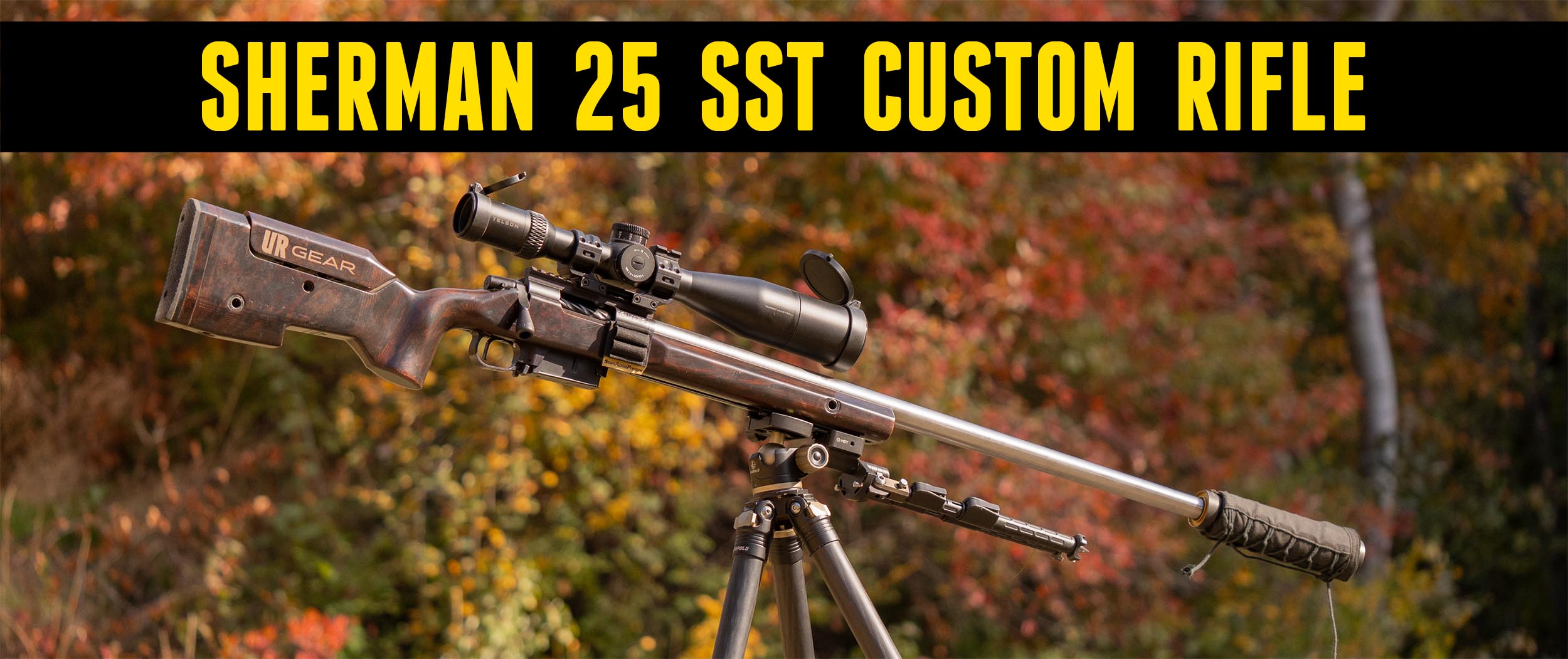
This time I’m building and shooting the most extreme 25 caliber rifle we’ve done to date at Ultimate Reloader. It’s chambered in 25 SST from Sherman Wildcat Cartridges, which pushes 25 caliber bullets faster than we’ve ever pushed them before.
Disclaimer
Ultimate Reloader LLC / Making with Metal Disclaimer: (by reading this article and/or watching video content you accept these terms). The content on this website (including videos, articles, ammunition reloading data, technical articles, gunsmithing and other information) is for demonstration purposes only. Do not attempt any of the processes or procedures shown or described on this website. All gunsmithing procedures should be carried out by a qualified and licensed gunsmith at their own risk. Do not attempt to repair or modify any firearms based on information on this website. Articles on this website are derived from original video content and may utilize artificial intelligence (AI) tools for initial drafting, transcript processing, and editorial refinement; no AI technology independently generates or verifies technical instructions or safety data. Ultimate Reloader, LLC and Making With Metal can not be held liable for property or personal damage due to viewers/readers of this website performing activities, procedures, techniques, or practices described in whole or part on this website. By accepting these terms, you agree that you alone are solely responsible for your own safety and property as it pertains to activities, procedures, techniques, or practices described in whole or part on this website.
About the 25 SST
The 25 SST is part of Sherman’s SST (Sherman Short Tactical) collection. It’s similar to the Sherman Short cartridges we’ve shown before, including our 6.5 SS and 7 SS builds.
The difference is a 30-degree shoulder instead of 45 degrees. That gives a bit of an optimization for feeding, while still delivering magnum-level case capacity and powder charges.
Sherman Wildcats supply both the brass and the dies. This is a custom Hornady die set with a full-length sizer and a seater.
Bill of Materials
The hardware will look familiar from our recent 6.8 Western build: a BAT Igniter short action with a magnum bolt face, our trusty Foundation Genesis 2 stock, a Hawkins M5 DBM and a 300 WSM magazine to feed these cases reliably.
What’s different is the barrel. I used a finished 28″ Krieger blank in a 1:7.5 twist, which is what this cartridge calls for. Krieger barrels have produced some of our best results of all.
For chambering, I used a solid carbide JGS reamer for 25 SST and an SST go gauge. All of the SST cartridges share the same go and no-go gauges.
To finish the rifle, I added a TriggerTech Diamond and a Telson TargetMaster 5-25 scope in an Area 419 one-piece mount.
About the Precision Matthews PM-1440HVT-2
I chambered the barrel on the Precision Matthews PM-1440HVT-2, a super high-quality variable speed lathe. One of its special features is the cast iron base, which makes it incredibly rigid and less prone to vibration.
Machining
I fired up Rifle Builder PRO to guide me through the process. I’d worked with Sherman Wildcats to add both the 25 SST and 7 Mega to the software natively, so I just selected the BAT Igniter short action and was off and running.
As always, I started by pre-drilling the chamber. You want a little over a half inch for a magnum chamber. After dialing in the throat area, I single-point bored an extra 0.030″ or so to get just under the shoulder diameter, leaving minimal material for the finish reamer.
Next came the tenon, one thread relief and a chamfer. I threaded the tenon at 18 TPI and hit the 1.023″ pitch diameter right on. With the action threaded almost up to the shoulder, there was just the slightest rattle at the tang, which is absolutely perfect. The shoulder squares up the action and the threads make it concentric.
I reamed about an inch on the first pass, then roughly 0.3″ and 0.2″ at a time. Once the shoulder of the reamer starts cutting, you have to slow down because it packs with chips. I’ve been steering away from pressure flush lately so I can do frequent runout checks, and I was amazed at how straight the chamber cut. There was no runout.
I confirmed the final depth with a slip-on ring, go gauge and depth micrometer, then checked headspace. Then I flipped the barrel and threaded the muzzle. This was the first barrel I’ve done with Rifle Builder PRO’s native muzzle threading, and its threading progress calculator tells you exactly how much infeed you need to bring the pitch diameter to the perfect value.
Assembly
I hand-tightened the action to set my clocking, then laser engraved the barrel with our Tykma Minilase. It looks super clean, with fewer raised edges than our old Chinese fiber laser.
After fully torquing the barrel on, I checked headspace again. I didn’t have a no-go gauge, so I used two 0.002″-thick pieces of Scotch tape on the go gauge to make a go-plus-0.004″ gauge. Go was a go, and no-go was a no-go.
I installed the TriggerTech Diamond, which is just two pins, and set it to about 7 ounces. It should make for a really nice bench or prone shooting experience.
The barreled action went into the Foundation Genesis 2, probably the most-used stock in our shop, with the Hawkins M5 DBM. Finally, I mounted the scope and torqued it down.
Shooting
If I had to pick a theme for this load development, it would be “if at first you don’t succeed, persist.” We’re dealing with a wildcat, and while Sherman has load data for all its cartridges, you don’t have thousands of shooters and OEMs contributing data. I had to do some detective work.
I started with Berger 135-grain Hybrids over 55.8 grains of H4831SC, with a Hybrid 46 suppressor. It ran over 3,000 fps with an 8.7 fps SD, but the group was about 1.2″. It’s easy to instantly blame the rifle, but sometimes switching the bullet or muzzle device is the answer.
Switching to Blackjack 131-grain bullets and N565 produced 3,331 fps with an 11.5 fps SD and some pressure signs, but still about a 1″ group. Backing off the charge and swapping to a brake for a completely different barrel tune gave 3,256 fps with a 7.7 fps SD, but a 1.3″ group strung out in a strange diagonal line. That looked like a load development artifact of being really out of tune.
At that point I was getting discouraged, but I moved on to the Hornady 138-grain A-Tip with N565. I also switched to the Area 419 Maverick Gen 1 suppressor, which has been consistently precise for whatever reason. Then I shot a quick ladder, working down in 0.3-grain steps.
60.0 grains printed a 0.529″ three-shot group with a little bit of pressure. 59.7 grains opened up to 0.723″, but the pressure signs improved. 59.4 grains produced a 0.338″ group at a 3,186 fps average with a 13.9 fps SD. Now I knew I was onto something.
My typical routine is to look for a good pattern in three-shot groups, then investigate with five-shot groups. Five rounds at 59.4 grains went into 0.379″ (0.36 MOA) from a bipod and rear bag, with a 3,169 fps average, 41 fps ES and 17 fps SD. This is the performance I’m looking for from one of my custom rifles.
Velocities ranged from a low of 3,071 to a high of 3,331 fps. You could probably tune a screaming load at the top end, but the compromise we found delivered great groups right around 3,175 fps. The A-Tip was the clear leader. I don’t think that means the Berger or Blackjack bullets won’t shoot in this rifle. With more time on seating depth, charge weight or powder, I’d expect to find a good combination for them too.
I did have some chronograph drops while shooting prone because of placement, not the chronograph itself. Next time I’ll aim it more precisely.
Conclusion
The 25 SST is an extreme 25 caliber cartridge that easily goes over 3,300 fps, and lighter bullets would push it even faster. The 30-degree shoulder aids feeding. If you want a little more case capacity, Sherman’s SS version has the 45-degree shoulder, but personally I really like this cartridge the way it is.
The BAT Igniter, Krieger barrel and Foundation stock all work together, and this thing is a hammer. I still need to get the SDs down and take it to distance, but I’m really happy that the rifle shoots like a tack driver.
Get the Gear
Don’t miss out on Ultimate Reloader updates, make sure you’re subscribed!
Thanks,
Gavin Gear
About the author