
If you are looking for a professional-quality Cerakote spray booth for your shop, choosing the right equipment is critical. The primary job of a spray booth is to safely extract fumes and overspray, but it also provides crucial lighting, room to maneuver, and hanging space for your projects. In this guide, we’ll break down the key considerations—including sizing, airflow calculations, venting options, and essential accessories—to help you optimize your setup.
Disclaimer
Ultimate Reloader LLC / Making with Metal Disclaimer: (by reading this article and/or watching video content you accept these terms). The content on this website (including videos, articles, ammunition reloading data, technical articles, gunsmithing and other information) is for demonstration purposes only. Do not attempt any of the processes or procedures shown or described on this website. All gunsmithing procedures should be carried out by a qualified and licensed gunsmith at their own risk. Do not attempt to repair or modify any firearms based on information on this website. Articles on this website are derived from original video content and may utilize artificial intelligence (AI) tools for initial drafting, transcript processing, and editorial refinement; no AI technology independently generates or verifies technical instructions or safety data. Ultimate Reloader, LLC and Making With Metal can not be held liable for property or personal damage due to viewers/readers of this website performing activities, procedures, techniques, or practices described in whole or part on this website. By accepting these terms, you agree that you alone are solely responsible for your own safety and property as it pertains to activities, procedures, techniques, or practices described in whole or part on this website.
Why a Professional Booth Matters
When you’re spraying Cerakote, proper equipment is essential for three main reasons:
- Finish Quality & Overspray Removal: Keeping overspray out of the air prevents particulate contamination on your freshly coated surfaces.
- Shop Safety & Health: Cerakote fumes and overspray are hazardous if inhaled (always use a proper respirator) and can be explosive. Using an explosion-proof fan and proper electrical considerations is non-negotiable.
- Local Code Compliance: Always check your local regulations regarding ventilation and hazardous material handling.
Sizing Your Booth
The first major decision is determining what you will be coating, how many items you are spraying simultaneously, and how much room you need to maneuver. Spraying handguns requires very little space, but coating full-length rifles or automotive components (like exhaust headers) demands a much larger working envelope.
For instance, a fully assembled or barreled rifle typically stands around 44 inches tall. You need enough height to suspend the muzzle or buttstock near the top of the booth while still having a foot of clearance above it and enough vertical room to angle and maneuver your spray gun when coating the very ends.
Built American offers several production booth sizes in their GS3 line:
- GS3-224 (24″ x 24″ x 48″): Perfect for smaller parts, optics, rings, and handguns. Runs on 110V (10 amps).
- GS3-446 (48″ x 48″ x 72″): A great mid-size option for rifles in smaller batches.
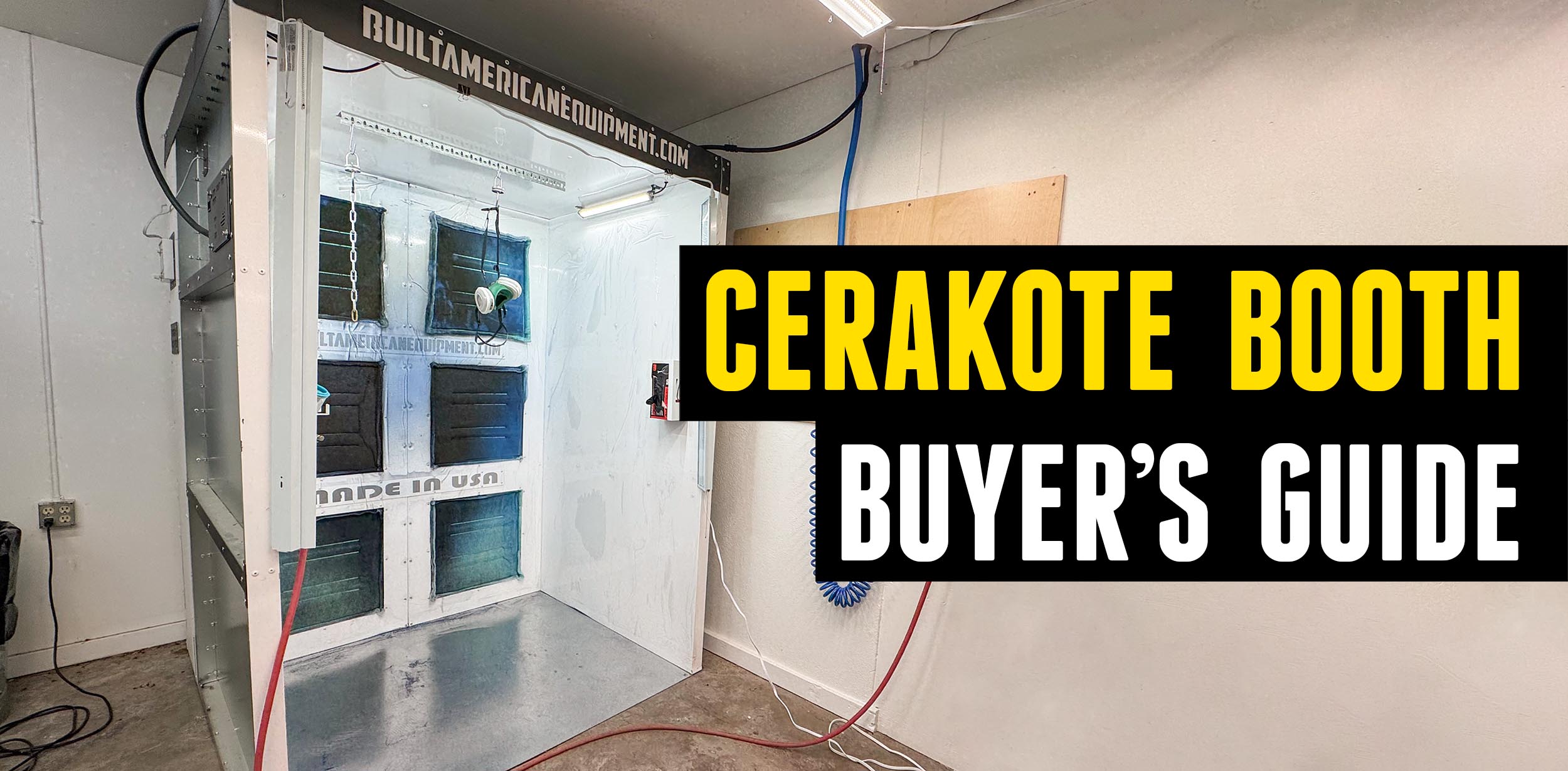
- GS3-457 (60″ x 48″ x 84″): The model we use in our shop. The extra headroom makes it ideal for medium-level production shops handling rifles, handguns, optics, and automotive parts.
- CRSB-500: Large industrial units designed for high-volume firearms OEMs.
Airflow and CFM Requirements
Proper airflow is calculated by multiplying the face square footage of your booth by 100 feet per minute of speed to determine the required CFM (Cubic Feet per Minute):
- GS3-224: ~800 CFM
- GS3-446: ~2400 CFM
- GS3-457: ~3500 CFM
Variable Speed Fans: I highly recommend investing in a variable speed fan system (roughly a $250 upgrade). When you are actively spraying, you want the fan on max to pull all material and fumes away. During flash times between coats or when prepping with acetone, you can dial the fan down to minimum just to gently draw out residual fumes without aggressively exhausting all your heated or cooled shop air.
Venting: Outside vs. Recirculating
You have two primary ways to handle your exhaust air:
- Venting to the Outside: The advantage is that all fumes are completely expelled from the building. The downside is that you are exhausting conditioned air, forcing your HVAC system to work harder, and you must ensure your shop has adequate make-up air inlets so the fan isn’t pulling a vacuum.
- Recirculating: Great for preserving your shop’s climate control, but leaves a slight residual fume smell that may require sectional partitioning or a small auxiliary extractor.
Essential Accessories & Options
When ordering your booth, it’s always easier to add options up front rather than retrofitting later:
- Differential Pressure Manometer (Magnehelic Gauge): Uses colored fluid to show the pressure differential between the inside of the booth and the exhaust, letting you know exactly when your filters are getting clogged and need replacing.
- White Powdercoated Interior & Protective Film: High light reflectivity is crucial for seeing how your finish lays down. Lining the interior with protective stair-tread film allows you to easily peel away overspray buildup and keep the walls bright white.
- Explosion-Proof Lighting & Fans: Standard equipment on quality professional booths to ensure safety around volatile solvents.
- Filter Replacements: Always keep spare stage filters and backup catch baskets on hand.
Conclusion
Choosing the right spray booth comes down to evaluating your largest parts, calculating your space and CFM needs, and deciding on venting and variable-speed airflow controls. Setting up your workspace correctly from day one ensures better finish quality, a safer environment, and higher productivity.
Do you have any questions about choosing a Cerakote booth or setting up your shop’s ventilation? Drop a comment below!
Get the Gear
Don’t miss out on Ultimate Reloader updates, make sure you’re subscribed!
Thanks,
Gavin Gear
About the author