
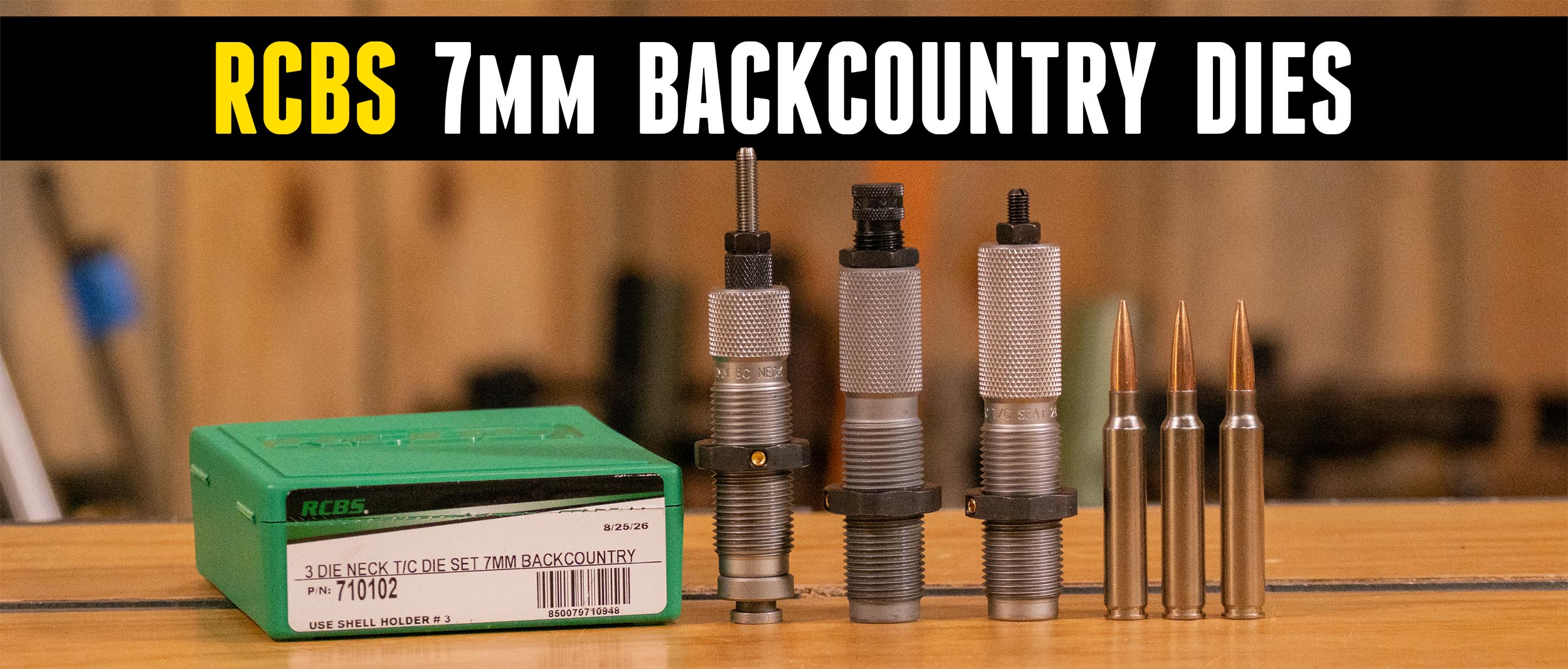
RCBS just launched their die set for 7mm Backcountry. In this article, we’ll take a look at the dies, use the new 7mm Backcountry-optimized powder, Accurate High Country, and load Federal Peak Alloy cases for the first time. This is going to be awesome. Watch or read on!
Disclaimer
Ultimate Reloader LLC / Making with Metal Disclaimer: (by reading this article and/or watching video content you accept these terms). The content on this website (including videos, articles, ammunition reloading data, technical articles, gunsmithing and other information) is for demonstration purposes only. Do not attempt any of the processes or procedures shown or described on this website. All gunsmithing procedures should be carried out by a qualified and licensed gunsmith at their own risk. Do not attempt to repair or modify any firearms based on information on this website. Ultimate Reloader, LLC and Making With Metal can not be held liable for property or personal damage due to viewers/readers of this website performing activities, procedures, techniques, or practices described in whole or part on this website. By accepting these terms, you agree that you alone are solely responsible for your own safety and property as it pertains to activities, procedures, techniques, or practices described in whole or part on this website.
About 7mm Backcountry
It’s been fun taking a look at 7mm Backcountry for the first time. When I first heard about the cartridge and its claims of approaching 7mm Magnum performance from a 20-inch barrel with a suppressor, I thought, “This looks interesting. How is that possible?”
It’s possible with Federal’s Peak Alloy cases. This steel case technology pushes pressures upwards of 80,000 PSI, almost 20,000 PSI above typical modern brass-cased cartridges. This could be a real game changer.
In the past few months, we did a story on the Geissele King Hunter in 7mm Backcountry. It’s a very nice, very accurate rifle. We had a couple of three-shot groups go into about half MOA with Federal factory ammunition loaded with a 175 grain projectile. I’d heard about reloading for 7mm Backcountry, and this whole steel case thing is a little bit different, so let’s dig in.
The RCBS 7mm Backcountry Die Set
The reloading process for 7mm Backcountry is a little different, and so is the die set. It’s a three-die set:
- Neck sizer and decapper: These steel cases are so strong that you can get away with neck sizing. It’s kind of a crazy concept, but it did play out, I promise you.
- Expander die: Gives the steel case mouth a little flare so you can seat bullets without scraping copper from the bullet jacket.
- Seating die: More or less a conventional bullet seating die, which also crimps.
RCBS Reloading Guide
Not only does RCBS provide the die set, they also supply 7mm Backcountry-specific instructions: “How to Reload 7mm Backcountry,” part of their advanced reloading series. It’s pretty comprehensive. Both Kyle on my team and I read it in preparation for this story, and it was really helpful.
The guide starts with an overview of 7mm Backcountry, how it’s unique, and how loading for it differs from typical brass-cased reloading.
- There’s basically no case prep. If you trimmed the cases, they’d corrode at the case mouth where you’d trimmed. It’s basically a turn-and-burn kind of thing.
- Neck size instead of full-length size. These are extremely strong cases, and if your chamber’s in spec, there won’t be enough plastic deformation (where the case doesn’t spring back to the same size) to need full-length sizing.
- Use the expander die to help guide the bullet in. The case mouth isn’t going to budge, so you need to provide just a little opening to avoid scraping the bullet.
The guide’s process is: neck size, then expand and flare, then prime and charge, then seat bullets. That’s exactly the process we followed, to a T. The guide also indicates that Accurate High Country is a purpose-built powder for the cartridge.
Load Data
In the Hodgdon load data center, selecting 7mm Backcountry brings up a warning that this is a higher-pressure cartridge, which totally makes sense. Selecting 175 grain bullets and Accurate High Country brings up another lengthy disclaimer, since cartridges normally top out at 65,000 PSI and this goes beyond that.
| Bullet | Powder | Starting Load | Max Load | Pressure |
| 175 gr | Accurate High Country | 59.1 gr | 63.6 gr | 76,500 PSI |
That pressure is high, so this is something to proceed with caution on and be extra sure of every step. But it’s really nice to see official load data available for consumer use.
Loading Process
I started with the neck-only sizer and decapper on our RCBS Rock Chucker Supreme. Setting up the die was super simple: I just touched it against the shell holder, and that was all that was needed.
I used wax case lube on the outside of the neck. There’s no need to lube the body, since we’re not sizing that part. I also used a Q-tip to lube the inside of the neck. Sizing was nice and smooth, and actually a little easier than I thought it would be.
Since this was a limited batch, I used the on-press priming. After wiping off the case lube, I individually primed five cases with Federal Large Rifle Magnum (215) primers. They primed really smoothly. The entrance to the primer pocket has a nice radius on it, which helps with priming.
Next, I swapped in the expander die. Setup is really easy: run a case all the way to the top of the stroke, screw in the die until the adjustment touches the case mouth, then go about another half turn. I had to turn it a little further than that.
RCBS indicates you want no more than 0.020 inch of flare. I used a 0.300 inch pin gauge to make sure I was in the right range, and sure enough, we were. Then I expanded the case necks.
I loaded the RCBS ChargeMaster Link with Accurate High Country and dispensed five charges.
One quick side note: with the RCBS interchangeable funnel kit, the 7mm insert wouldn’t fit over the expanded case mouth, but the 30 caliber insert was just perfect.
With my lock rings locked down, I can swap dies in and out without disrupting settings. I removed the expander die and installed the bullet seating and crimping die.
I’m not used to crimping bottleneck bolt-action cartridges, so I took a different approach to setting up this die. I wanted to get the bullet seated in position first, then work the crimp adjustment:
- Put a round of Federal 175 grain factory ammunition in the press as a dummy, raise the ram, lower the die until it’s basically touching the case mouth, then lower the seating stem until it contacts the bullet.
- Put a case to be reloaded in the press and seat a Berger 175 grain Elite Hunter.
- Withdraw the seating stem, then progressively work the die down to set the crimp.
- Using digital calipers, compare the middle of the neck to the case mouth, and work the die down until there’s a thousandth or less of flare remaining. That removes almost all of it without over-crimping. I was very, very careful about that.
- Run the seating stem back down, apply a little pressure, and lock it down.
That worked super well. The 175 seems to be the sweet spot for 7mm Backcountry, and the factory ammunition we’d tried with that weight shot really well. I’d also just gotten in a bunch of the Berger Elite Hunters, so we decided to give them a try.
You can feel that crimping a steel case is a little different. It’s not as soft or as workable as brass. But I’ve been surprised at how well these dies work and how straightforward they are to adjust and dial in. It’s also nice not having to full-length size.
Range Testing
Kind of like the first time I squeezed off a 44 Magnum load, my very first handload ever, there were some nerves there. When you’re approaching 80,000 PSI and you’re used to a little less than that, it’s an interesting feeling.
We started with three charge weights:
| Charge (Accurate High Country) | Relative to Max | 3-Shot Group |
| 62.6 gr | 1.0 gr under | 1.057 in |
| 63.6 gr | Published max | 0.339 in |
| 64.1 gr | 0.5 gr over | 1.017 in |
Don’t use this load data. Always look up load data from an OEM source and verify it, and for this cartridge, I’d say use at least two sources if you can.
The 63.6 grain published max load put three shots into 0.339 inch. Unfortunately, I didn’t have the screen capture running at that point, so it isn’t on camera, but you can see it on the target. It also had a very favorable SD, right at about 10 fps.
Velocities
| Charge | Avg. Velocity | SD |
| 62.6 gr | 2,823 fps | 10.4 fps |
| 63.6 gr | 2,848.7 fps | 9.7 fps (10 shots, two 5-shot groups) |
Velocity was very consistent. We didn’t alter the charge weight a whole lot, staying within a grain and a half over the whole span, but we must have been on some sort of node, given the stable velocity just over 2,800 fps.
One of the five-shot groups went into 0.735 inch. That goes along with what we’ve seen with this rifle so far: around five shots, things start to open up a little bit.
Berger 180 Hybrid
I also experimented with the Berger 180 grain Hybrid in a couple of three-shot groups:
| Charge | 3-Shot Group |
| 62.0 gr | 0.619 in |
| 62.4 gr | 0.8 in |
We’ll have to come back to that one. I decided to focus my efforts on the 175, because it seems to be a great weight, and it’s a hunting bullet for a hunting rifle.
Update: Matching Factory Velocity
After filming, we got some late-breaking updates from Hodgdon with some tweaks to the load data, and we were able to take performance a little further with Accurate High Country and our King Hunter.
Working up in roughly half-grain increments, we pushed our 175 grain Elite Hunters to 2,970 fps. What’s really notable is that this was 2 fps over what the Federal Fusion factory ammunition produced.
That’s significant, because we’re at par with factory ammunition. Manufacturers can sometimes run really hot loads, and it can be tough to know what it will take to reproduce that with your own handloads. We were spot on here. You can get the latest Accurate High Country data from the Hodgdon reloading data center, and I’d love to see what kind of velocities you produce.
Pressure Signs
We did see primers flatten just a little bit with the Federal 215 Large Rifle Magnum primers. Some of the other reading I’ve done suggests you want a pretty hard primer cup, and that you can’t read pressure signs like you normally would.
Here’s what we know so far:
- Smooth chambering and extraction: With the cases fired in this rifle and reloaded, chambering and extraction were surprisingly smooth.
- Primers backing out slightly: We saw primers back out of the case just a little, which we also saw with the factory ammunition.
This is new territory for us, so we’re still learning how to read and interpret the signs.
Final Thoughts
This was an interesting experiment, and I think the results are really promising. It’s the first step, and I think it’s only going to get better with more bullets, additional load development, and getting more comfortable pushing to higher velocities, knowing there will be trade-offs.
When we shot factory ammunition in our initial King Hunter review, we did have intermittent sticky extraction. This is definitely a case where you’re pushing the edge and the limits a little bit, and it’s all about knowing where the sweet spot is for what you’re doing.
What I do know is that the King Hunter, with its 20-inch barrel and a suppressor, is a very compact, very effective package. Ammunition pushing 80,000 PSI helps get magnum performance out of a shorter barrel. That’s the equation.
We’re also just getting started with Accurate High Country. It’s not just for high-pressure scenarios; it’s going to be well suited to other magnum cartridges. We’ll take a more in-depth look at that, and do more reloading for 7mm Backcountry, in the future, so stay tuned!
What do you think about this crazy steel case reloading scenario, the RCBS dies, and the performance we got? If you have questions, thoughts or things you want us to look into, let me know in the comments!
Get the Gear
RCBS 7mm Backcountry Die Set (Use code UR10 to save 10%!)
Shop Accurate High Country at Hodgdon (Use code UR10 to save 10%!)
Don’t miss out on Ultimate Reloader updates, make sure you’re subscribed!
Thanks,
Gavin Gear
About the author