
Shooting factory subsonic ammunition can get really expensive. Loading your own subsonic ammo can save you a tremendous amount of money, and it can also unlock some things you can’t do with factory ammunition. In this article, we’ll look at the economics of subsonic handloads, from bullet and powder choices to the real cost per round. Watch or read on!
Disclaimer
Ultimate Reloader LLC / Making with Metal Disclaimer: (by reading this article and/or watching video content you accept these terms). The content on this website (including videos, articles, ammunition reloading data, technical articles, gunsmithing and other information) is for demonstration purposes only. Do not attempt any of the processes or procedures shown or described on this website. All gunsmithing procedures should be carried out by a qualified and licensed gunsmith at their own risk. Do not attempt to repair or modify any firearms based on information on this website. Articles on this website are derived from original video content and may utilize artificial intelligence (AI) tools for initial drafting, transcript processing, and editorial refinement; no AI technology independently generates or verifies technical instructions or safety data. Ultimate Reloader, LLC and Making With Metal can not be held liable for property or personal damage due to viewers/readers of this website performing activities, procedures, techniques, or practices described in whole or part on this website. By accepting these terms, you agree that you alone are solely responsible for your own safety and property as it pertains to activities, procedures, techniques, or practices described in whole or part on this website.
Subsonic Shooting Concepts
Before we get to the money, here’s a quick recap of the concepts.
Some cartridges and applications are subsonic by their very nature, like 45 ACP. There’s not a whole lot to think about there; you’re somewhere around 900 fps, and it’s just subsonic, period.
But when you step up to something like 300 Blackout, you’ve got a heavy bullet traveling slow. That heavy bullet costs a lot of money, and it needs to operate within a specific window. With rifle, we want to push performance a little further. We use a heavier bullet to preserve as much momentum as we can, and we want to get close to the speed of sound without going over it. If you’re not using hearing protection and a supersonic round goes off, which can definitely happen, it’s going to give you a crack that can be very detrimental to your hearing.
The Velocity Window
For rifle, we’re really homing in on 1,030 to 1,070 fps. That preserves as much kinetic energy as possible without risking going supersonic, and it leaves a bit of buffer. The speed of sound is about [VERIFY: 1,100] fps, maybe 1,110 as shown on our chart, and we just need to be very intentional about staying below it.
So that’s the game: heavy-for-caliber bullets in the 1,030 to 1,070 fps range. That’s where your chronograph comes in super handy. You’ll want a powder that burns consistently and cleanly and gives you a consistent velocity in the range you specify.
Reloading for Subsonic
You use the same equipment for subsonic as for anything else: a single stage, turret or progressive press. It’s essentially the same process.
Where you’ll run into differences is with things like bullet feeders. When you’ve got a little 300 Blackout case with a huge 220 grain bullet on top, the center of gravity gets all out of whack. Bullets can topple off, and cases start to behave funny in the shell plate and in the press. Sometimes it makes more sense to slow things down a bit. That’s why, if I’m loading on a progressive, I might choose a Dillon RL 550, which doesn’t auto-index. You place the bullet, you go up, and it seats.
As long as you keep those special cases in mind, it basically comes down to the components: specific bullets and specific powders. If you’re loading handgun, there might be nothing to think about here at all. There are a lot of subsonic 9mm loads, and 45 ACP is subsonic. Then you’re just thinking about whether your handgun will function properly with a suppressor, and which suppressor to use, but that’s a whole different topic.
Choosing Economical Bullets
The bullet is perhaps the most important choice, and it’s where the bulk of the savings come in. I was talking to my friends at Midsouth Shooters Supply about this opportunity for savings, and it’s very real. These are real numbers:
| Bullet | Type | Cost Each | Savings vs. Berger 200 |
| Berger 200 gr 30 cal | Jacketed | $0.77 | Baseline |
| Berry’s 220 gr 30 cal | Plated | $0.27 | 65% |
| Magnus 165 gr 30 cal | Hardcast lead | About half the Berry’s | 83% |
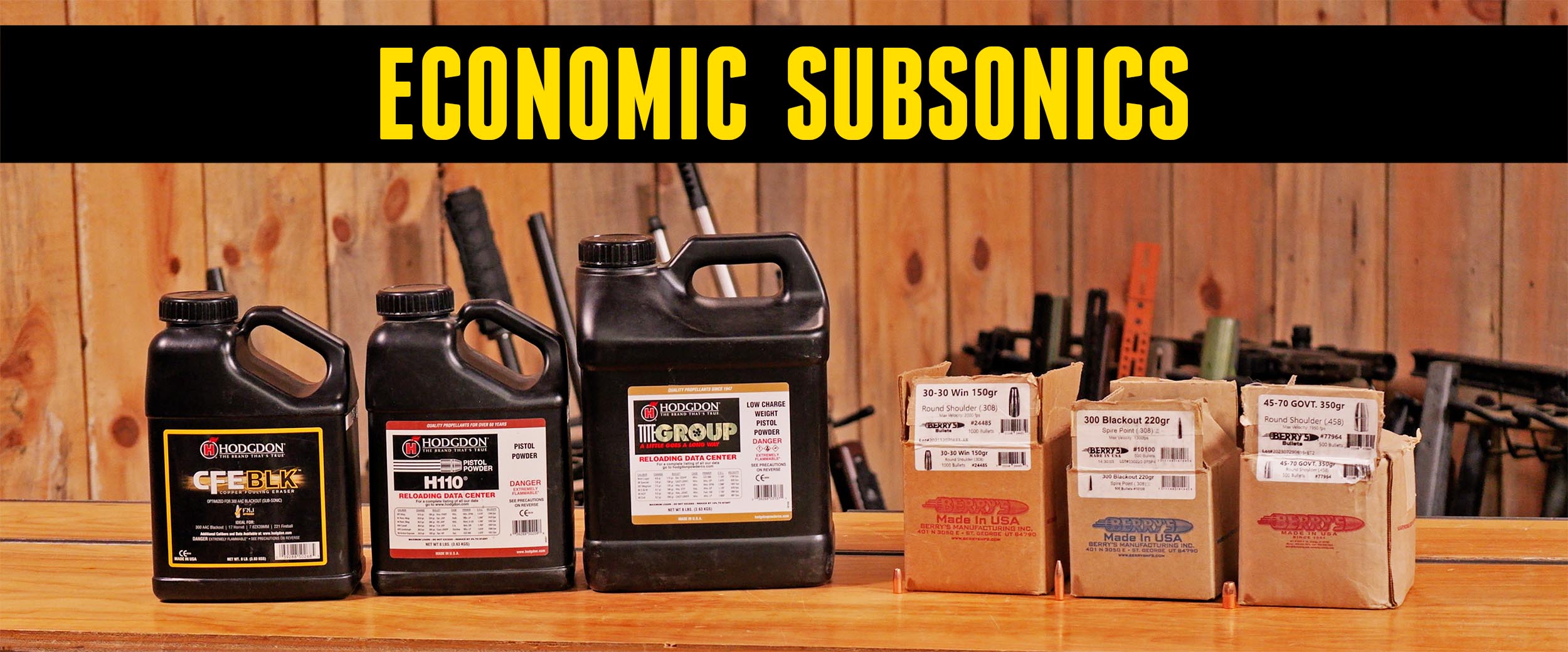
The Berger 200 grain jacketed bullet is a good baseline. Stepping over to a plated bullet brings drastic savings just in that transition from jacketed to plated. We’ve shown the Berry’s 220 grain plated bullet in 308, 7.62×39 and 300 Blackout. It’s a great subsonic bullet: very versatile and very cost effective.
If you want to go even further, you can go to hard cast lead, like the Magnus 165 grain. Yes, it’s a 165, not a 200, but it’s about half the cost of the Berry’s 220. So we have expensive, economical, and really economical at the cost of some bullet weight.
The bullet itself makes a huge difference. Think about what kind of performance you need and what your application is. The bullet weight might also dictate a different powder.
Selecting Subsonic Powders
Hodgdon has subsonic-specific load data in their rifle reloading data, which is a huge help. (Again, if you’re loading pistol, you don’t really need to think about this.) The rifle data is broken into standard, subsonic and reduced recoil, and some of those reduced recoil loads happen to be subsonic too. That data will help steer you in the right direction.
Here are a few powders we use most frequently for subsonic loads.
We just did a complete tested story on H110 with a whole bunch of applications and data. I use it for magnum handgun and for 300 Blackout, and there have been other applications in the subsonic domain as well.
CFE BLK is a subsonic-specific powder designed for 300 Blackout and for heavy-for-caliber bullets like 200s and 220s. It also has a copper fouling eliminator, which is where the “CFE” comes from. It’s a very versatile powder and a really top performer. We’ve used it in 7.62×39 with the Berry’s 220s, which is a very, very fun round to shoot subsonic. The AK actually works really well with it, which really surprised me.
Then there are specialty subsonic loads. You wouldn’t think of 223 Remington as a subsonic cartridge, but if you look in the data, it’s there. In fact, doing some Titegroup loads for it is on my list. If you’re curious about a specific cartridge, check out the subsonic load data, and you’ll probably find Titegroup in a bunch of those specialty loads. It just happens to work really well with low case fill and subsonic velocities.
Cost Savings Analysis
Here’s the math behind the savings visual from the beginning. Ultimate Reloader PRO has a tools section, and one of those tools is a cost calculator. I ran the numbers for 300 Blackout with these assumptions:
- Bullet: Berry’s 220 grain plated
- Powder: H110
- Brass: Reused (I have plenty of both converted brass and originally factory brass)
| Cost per Round | |
| Subsonic handload | About $0.37 |
| Hornady factory 300 Blackout subsonic | About $1.77 |
| Savings | $1.38 per round (79%) |
If you shoot 1,000 rounds, that’s $1,380 saved. That’s really substantial; it’s like a 300 Blackout rifle right there.
Again, this assumes you’re reusing your brass. The good news is that subsonic loads are lower pressure, so the brass doesn’t get beat up. Primer pockets will hold, and you won’t get splitting like you will with higher-pressure, super-demanding loads.
Converting Brass
Another way to save money is converting brass. For 300 Blackout, you can take military once-fired or range-pickup 223/5.56 brass and convert it. You can even use a motorized press setup like our Dillon CP-2000, automated with an [VERIFY: RT 1500] trimmer, to do this in bulk: thousands and thousands of cases.
The process starts with a 223 case. The shoulder gets pushed back, then the case gets trimmed, and you’ll want to chamfer and deburr. If you’re doing it manually, it’s a little bit of work, but it’s actually really satisfying and fun. We have a full video on this topic showing the setup, the process and all the special considerations for this type of conversion.
Conclusion
Factory subsonic ammunition is expensive. Subsonic reloads are both effective and thrifty.
- You’ll save a ton of money.
- You can tune everything for your firearm. That’s a very specific advantage. If your AR isn’t cycling and you’re not getting the performance you want, you can adjust things on both the firearm side and the load side.
- Low powder charges are easy on your wallet. You’re using 9 or 10 grains compared to 40 grains or whatever it is for a full-house supersonic centerfire cartridge. In this economy, that really matters.
- Versatile powders save money too. If you load magnum handgun and 300 Blackout subsonic with the exact same powder, that means fewer powders on the shelf and potentially less waste and redundancy.
The net effect is more shooting and less money spent.
Get the Gear
Berry’s .30-Caliber 220-Grain Plated Bullets at Midsouth Shooters Supply
Berger .30-Caliber 200-Grain Hybrid Target Bullets at Midsouth Shooters Supply
Magnus .30-Caliber 165-Grain Hard Cast Bullets at Midsouth Shooters Supply
Hodgdon H110 at Midsouth Shooters Supply
Hodgdon CFE BLK at Midsouth Shooters Supply
Hodgdon Titegroup at Midsouth Shooters Supply
Dillon RL550C at Midsouth Shooters Supply
Dillon CP2000 at Midsouth Shooters Supply
Shop all reloading components and equipment at Midsouth Shooters Supply!
Don’t miss out on Ultimate Reloader updates, make sure you’re subscribed!
Thanks,
Gavin Gear
About the author