
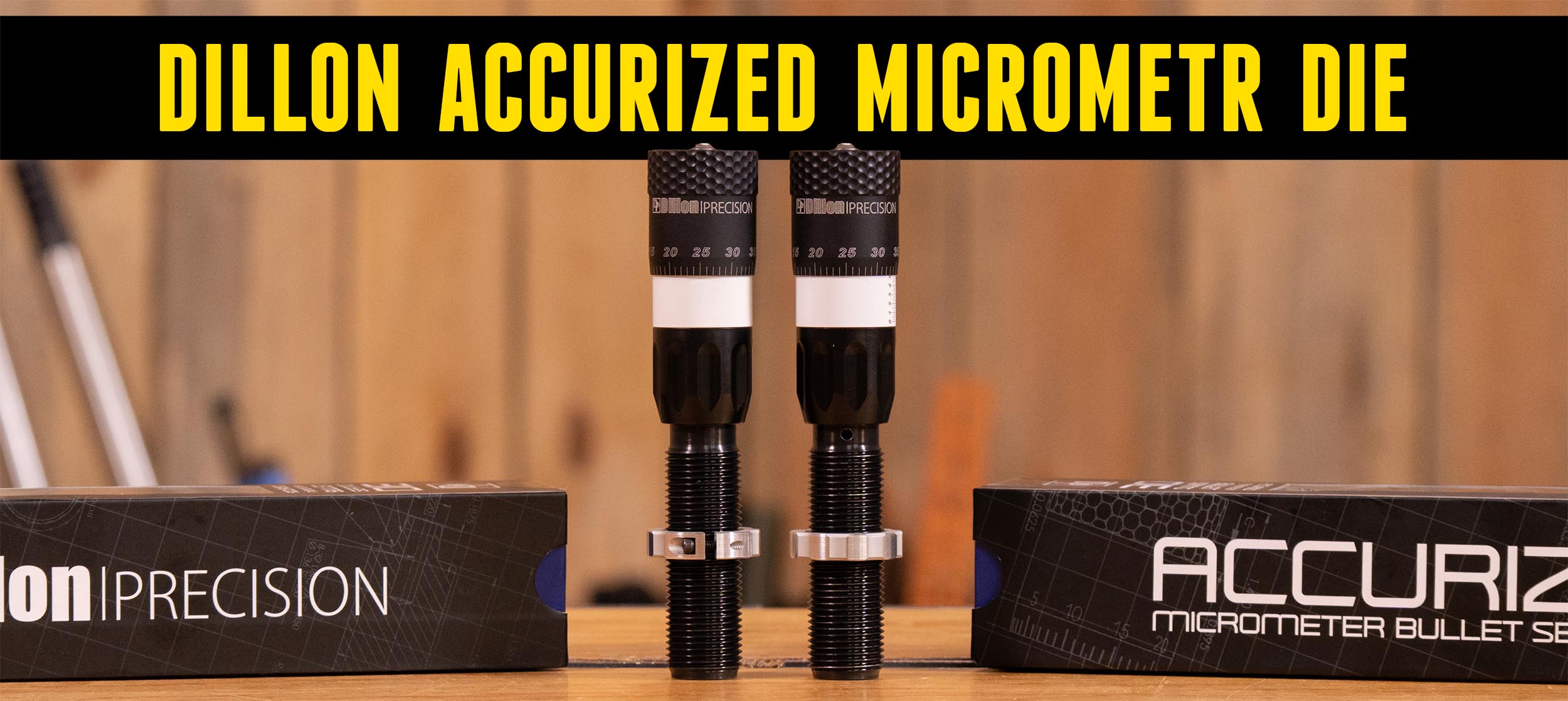
When Dillon Precision first showcased their modular, accurate micrometer seating dies at Shot Show, precision reloaders took notice. Recently, we got our hands on a couple of these dies to put them through rigorous, real-world testing on the bench—evaluating modular internal kits, ease of setup, bullet runout, and concentricity across both progressive and single-stage presses. Let’s take a deep dive into how these new dies are constructed, how the modular caliber conversion kits work, and what kind of runout numbers they produce on the target!
Disclaimer
Ultimate Reloader LLC / Making with Metal Disclaimer: (by reading this article and/or watching video content you accept these terms). The content on this website (including videos, articles, ammunition reloading data, technical articles, gunsmithing and other information) is for demonstration purposes only. Do not attempt any of the processes or procedures shown or described on this website. All gunsmithing procedures should be carried out by a qualified and licensed gunsmith at their own risk. Do not attempt to repair or modify any firearms based on information on this website. Articles on this website are derived from original video content and may utilize artificial intelligence (AI) tools for initial drafting, transcript processing, and editorial refinement; no AI technology independently generates or verifies technical instructions or safety data. Ultimate Reloader, LLC and Making With Metal can not be held liable for property or personal damage due to viewers/readers of this website performing activities, procedures, techniques, or practices described in whole or part on this website. By accepting these terms, you agree that you alone are solely responsible for your own safety and property as it pertains to activities, procedures, techniques, or practices described in whole or part on this website.
Modular Design & Swappable Internals
The core innovation of Dillon’s Acurized micrometer seating die system is its modularity. When you purchase a die, it comes with a robust die body assembly and conversion capability. Inside, the swappable internals include:
- A Shoulder Centering Sleeve: Keeps the case perfectly aligned.
- Dual Seating Stems: Each caliber kit includes two distinct seating stems—one optimized for secant ogive bullets and another optimized for tangent ogive bullets (such as Berger hybrid designs).
Switching between calibers or bullet profiles is remarkably fast. You simply remove the top micrometer assembly and spring, drop in the correct centering sleeve and seating stem, and reassemble. Furthermore, the micrometer features a top set screw to zero the dial, and a rotatable vernier scale that lets you position the markings facing you once the die is locked into your press.
Testing on the Dillon RL550 (Progressive Press)
For our first test, we mounted the die in station four of our Dillon RL550C progressive press, set up to load 6 Dasher with Berger 109-grain hybrid bullets.
After dropping a powder charge and indexing a dummy case into position, we dialed in our seating depth using the micrometer head. Once adjusted, we loaded a batch of test rounds. When measured on a precision bullet runout gauge, the progressive-loaded rounds yielded outstanding numbers—hovering right around plus or minus 1 to 2 thousandths of an inch total indicator reading, which is exceptional for ammunition produced on a progressive press.
Testing on a Single-Stage Press
Next, we moved the system over to an Area 419 single-stage press to test a 224-caliber configuration using 45-grain Sierra Tipped GameKing bullets in both brand-new Peterson brass and previously fired brass.
The concentricity results here were staggering:
- Brand-New Brass: Produced a total indicator reading of roughly 1 thousandths of an inch (plus or minus a half-thousandth), indicating that the die itself introduces virtually zero runout.
- Previously Fired Brass: Maintained nearly identical, highly consistent numbers, proving that the modular design performs on par with (or exceeds) dedicated single-cal, single-stage custom seating dies.
Conclusion
Dillon Precision’s new micrometer seating dies bridge the gap between high-volume progressive reloading and match-grade precision. By allowing reloaders to swap internal sleeves and stems for secant and tangent profiles while utilizing cost-effective conversion kits across multiple calibers, Dillon has delivered an exceptionally versatile and accurate system.
What do you think of Dillon’s new accurized micrometer seating dies, and would you run them on a progressive or single-stage press? Drop a comment below!
Get the Gear
Dillon Accurized Micrometer Bullet Seating Die
Don’t miss out on Ultimate Reloader updates, make sure you’re subscribed!
Thanks,
Gavin Gear
About the author