
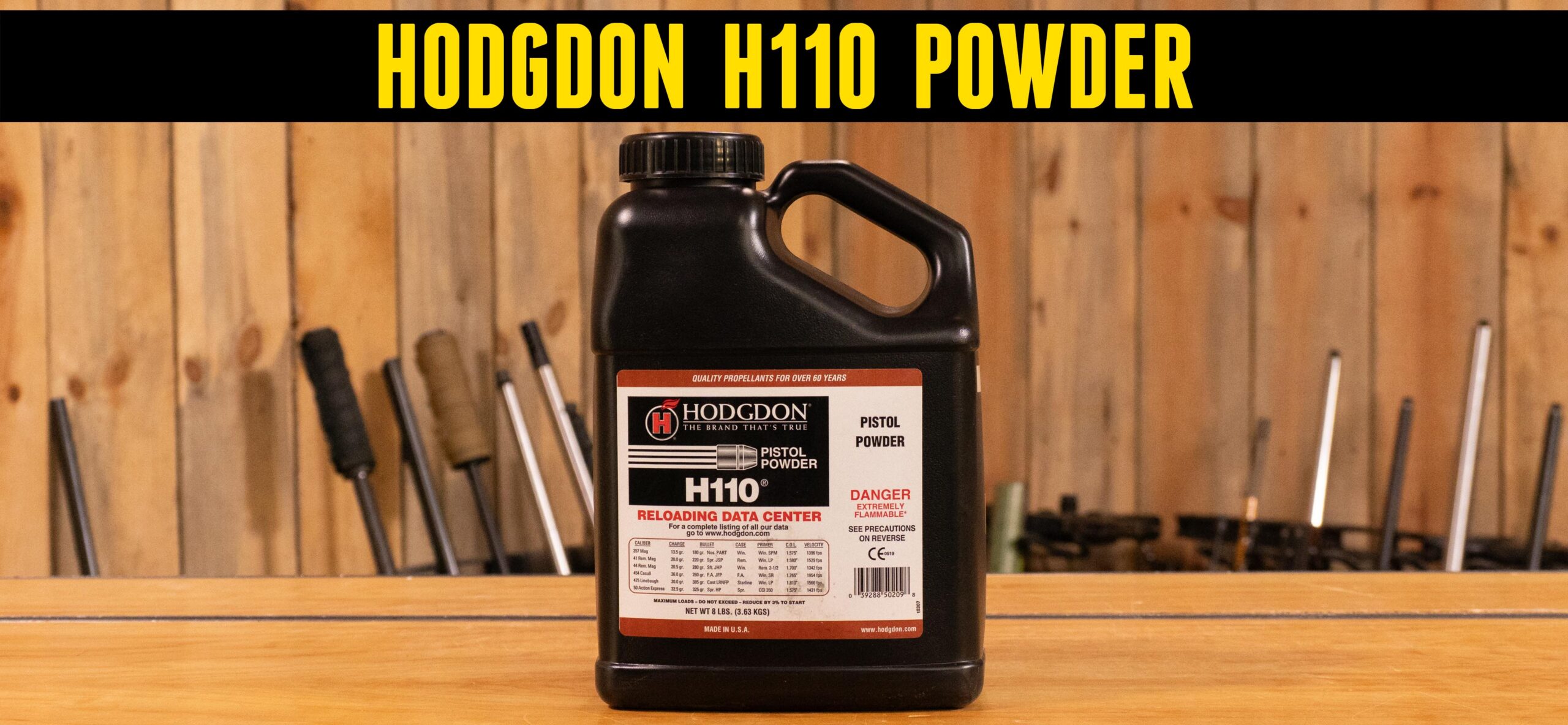
In this article, we’re looking at a powder we use all the time here at Ultimate Reloader, one that lives in two different worlds: Hodgdon H110. We’ll cover magnum handgun loads, subsonic rifle loads, other applications, and how H110 compares to CFE BLK. Watch or read on!
Disclaimer
Ultimate Reloader LLC / Making with Metal Disclaimer: (by reading this article and/or watching video content you accept these terms). The content on this website (including videos, articles, ammunition reloading data, technical articles, gunsmithing and other information) is for demonstration purposes only. Do not attempt any of the processes or procedures shown or described on this website. All gunsmithing procedures should be carried out by a qualified and licensed gunsmith at their own risk. Do not attempt to repair or modify any firearms based on information on this website. Articles on this website are derived from original video content and may utilize artificial intelligence (AI) tools for initial drafting, transcript processing, and editorial refinement; no AI technology independently generates or verifies technical instructions or safety data. Ultimate Reloader, LLC and Making With Metal can not be held liable for property or personal damage due to viewers/readers of this website performing activities, procedures, techniques, or practices described in whole or part on this website. By accepting these terms, you agree that you alone are solely responsible for your own safety and property as it pertains to activities, procedures, techniques, or practices described in whole or part on this website.
Why H110?
H110 is one of those powders we just keep coming back to. We do a lot of loading and a lot of shooting with it, and the reason is its versatility. If I’m looking for a magnum handgun powder that will give me maximum velocity (and yes, maximum recoil as well), I go to H110. We’ve used it in 357 Magnum, 44 Magnum and 500 S&W Magnum. But there’s a whole other world it likes to live in, and that’s cartridges like 300 AAC Blackout.
H110 Basics
- Designed for: Straight-wall loads, near max
- Load window: Not a huge window between min and max; it likes to run at max or just under
- Primer: Magnum primer
Hodgdon cautions you not to go very far below max, because the burn just gets unstable.
On the primer side, that means small pistol magnum primers for 357 Magnum and large pistol magnum primers for 44 Magnum. When you step up to 500 S&W Magnum, though, you’re really loading for a rifle, and the primer is no exception. The H110 load I looked up for a 400 grain projectile specifies a large rifle magnum primer. That is a potent setup: top velocity, heavy recoil and one heck of a fireball. If you’re shooting at night, it really lights things up.
Magnum Handgun Loads
Here are a few of the H110 handgun loads that I and Guy Miner have shown in various stories.
44 Magnum
23.5 to 24 grains of H110 behind a 240 grain projectile is an absolutely classic 44 Magnum load. It’s a canonical load, proven to be very accurate and to push really high velocities. Check out a couple of the loads Guy Miner produced great numbers with in his Ruger Bisley with a 7.5-inch barrel:
| Bullet | H110 Charge | Avg. Velocity | SD |
| 240 gr Hornady XTP | 23.5 gr | 1,389 fps | 3 fps |
| Berry’s 240 gr Target Hollow Point | 23.5 gr | 1,330 fps | 11 fps |
An SD of 3 is a number I’d be really happy with in a precision rifle load! That’s the kind of performance we’ve come to depend on with H110: heavy-hitting and very consistent, as long as you’re using a magnum primer and you’re up near max.
357 Magnum: Revolver vs. Lever Gun
We’ve also had interesting results comparing H110 performance in a S&W 586 and in our Henry lever gun, using 15.5 grains of H110 behind a Berry’s 158 grain Flat Point Thick Plate:
| Firearm | Avg. Velocity |
| S&W 586 | 1,120 fps |
| Henry, 20-inch barrel | 1,622 fps |
H110 can do really well in a variety of configurations with magnum handgun cartridges, and that’s just one of the reasons we tend toward H110 for magnum handgun applications.
Subsonic Rifle Applications
There’s a formula for subsonic rifles: the heavy bullet, the small charge and the large case volume. H110 works well for subsonic heavy-bullet applications in this context, and also for supersonic, lighter-bullet 300 Blackout applications. Its fast burn rate builds working pressure.
Again, you definitely need magnum primers. That’s kind of a theme here. Magnum primers give you lower SDs and more reliable ignition, and with H110 being a bit more particular about ignition and burn variables, it’s worth it to step up to the magnum primer.
For these applications, I have a CMMG Dissent, which is a shorter-barreled configuration, and a 16-inch carbine-length AR-15.
Cycling and Velocity Targets
One thing you’ll want to pay careful attention to across the board with ARs, but especially with subsonics or when switching between supersonic and subsonic loads, is the cycling of the action. There are a bunch of configuration options there, but the load itself can make a big difference in how the action cycles and functions.
We typically target 1,050 fps, because it gets us far enough below supersonic that we have a little bit of fudge factor. What you don’t want is an 1,150 fps round causing a crack if you’re not using hearing protection. We talked about this window in one of our recent videos on how to use subsonic load data, and it’s a really important consideration.
Our SDs have landed somewhere between 8.5 and 15 fps, depending on the load. As we increased charges toward max, that’s when we saw the 8.5 fps numbers. It goes to show that the window is a little smaller with H110, and that’s something you really want to pay attention to.
Plated Bullets
If you’re using plated bullets, be aware of velocity. There’s typically a maximum velocity for plated bullets, and if you move a load over to a lever gun, you might go beyond it. You might start to blow the plating off the bullet, which can impact your accuracy, and if you’re using a suppressor, that’s obviously not good.
Troubleshooting Function
If you’re encountering issues, which are more likely on compact AR platforms or other semi-auto platforms, look at your buffer, your spring and, if you have one, your adjustable gas block. All of those together help with functioning and performance.
Subsonic Load Testing
Two cartridges that have done really well with H110 over the years are 300 Blackout and 7.62×39.
300 Blackout (16-inch AR)
| H110 Charge | Avg. Velocity | SD |
| 9.0 gr | 977 fps | 15.6 fps |
| 10.0 gr | [VERIFY: 1,14x] fps | 8.5 fps |
Just one grain more got us a lot more velocity and a much tighter SD. We might want to back that 10-grain load off ever so slightly to get down to about 1,050 fps, but it shows you that the window approaching max charge is really where you want to focus your attention and do your fine-tuning.
7.62×39
With 7.62×39, we saw similar results but a little higher SD, using 10.7 grains of H110 behind a [VERIFY: Berry’s 220 grain] bullet. That bullet is slightly under nominal diameter for the .311 AK platform, but it still works great for plinking.
| Firearm | H110 Charge | Avg. Velocity | SD |
| PSA KS-47, 8.5-inch barrel | 10.7 gr | 938 fps | 18 fps |
| Full-size AK-47 | 10.7 gr | 1,076 fps | 18.7 fps |
Interestingly, the same load produced about the same SD, but obviously different velocity based on barrel length.
Probably the most important takeaway from that whole project was that the full-size AK-47 will eat anything, just as its reputation dictates. It’s known as the garbage disposal of ammo. The KS-47 required much more attention to load specifics and to all the setup variables I mentioned for the AR platform: buffer weight, spring weight and adjustable gas block. It didn’t happen to have an adjustable gas block, but it was more finicky with ammo, and that’s just something you have to be aware of.
Other H110 Applications
500 S&W Magnum
Our biggest H110 application is the 500 S&W Magnum. I have it set up to load on our RCBS Pro Chucker 5, with the powder measure labeled H110. We always keep blue tape on our powder kegs, and when we fill a measure, we put blue tape on the powder reservoir too, so we don’t get them mixed up. I have a great video on this.
I also still have my shims from a 38/357-style trick I did with 500 S&W Special and 500 S&W Magnum, where we pop the dies up and down by the appropriate distance using shims. That worked really well, and H110 is a great performer in the 500.
More Cartridges
- 454 Casull
- 475 Linebaugh
- 460 S&W Magnum
- 30 Carbine
- .410 bore shotshells
30 Carbine is an interesting one. I don’t have anything chambered in it, so if you have experience with H110 in 30 Carbine, let me know in the comments how it’s performed for you.
We also frequently see crossover between pistol and shotshell applications. It’s kind of an interesting thing, but there’s definite overlap there in powder burn rate.
Also, a reminder: Winchester 296 is the same powder as H110, just labeled under a different brand.
H110 vs. CFE BLK
Under the Microscope
From our prior CFE BLK story, here’s a look at a few powders under the microscope:
- CFE BLK: True spherical powder
- CFE Pistol: Flattened ball
- H110: Also flattened ball, but less flat
- Varget: Short stick powder
The thing to note is that H110 and CFE BLK will meter phenomenally on a progressive press with a rotating drum powder measure, because of the shape of the granules and how consistently they meter.
Key Differences
If you’ve been loading or researching subsonic ammunition, you’ve probably noticed both of these powders. They have some overlap, but also some key differences. We have a complete tested story on CFE BLK and multiple reloading stories on 7.62×39 and 300 Blackout comparing these powders, but here are the quick CliffsNotes:
- Design intent: CFE BLK was engineered for heavy subsonic applications, like 200-ish grain bullets in 300 Blackout. H110 was engineered for basically maximum performance in a magnum handgun.
- Heavy subsonics: You’ll probably see slightly better performance with CFE BLK.
- Supersonic 300 Blackout: H110 might give you the edge.
- AR cycling: CFE BLK might have a slight advantage, because of the way it builds and sustains gas pressure.
- Copper fouling: CFE BLK has a copper fouling eliminator (that’s what “CFE” stands for). H110 does not.
My Recommendation
If you have both powders on your bench, develop loads for both, get out your chronograph, and test with any configurations that matter to you. If I’m loading 300 Blackout, I’ve got the short-barreled Dissent and the 16-inch carbine, so I’m going to test with both. Same with the KS-47 and AK-47: if I plan to shoot a load in both, I’ll test in both.
I’ll look at average velocity, and in this case, maximum velocity too. It’s the only case where I actually care about max velocity, because I want to see if I’m pushing over that 1,100 to 1,150 fps threshold. I’m also going to look at SD to see how consistent the velocity is. Sometimes you’ll see first-round differences with a cold bore and a cold suppressor, which is something I’ve been noting as well. All of these things can help you decide between CFE BLK and H110.
Conclusion
H110 is consistent across cartridges, but not necessarily across charges. Again, it wants to be pushed to the max.
- Magnum handgun: Near max only, with a magnum primer
- Subsonic rifle: Typically a lighter charge, tuned for function with all of the AR variables we talked about
It’s great for handgun hunting, great for target work and great for subsonic applications.
Get the Gear
Hodgdon H110 (Save 10% with code UR10.)
Hodgdon CFE BLK (Save 10% with code UR10.)
Don’t miss out on Ultimate Reloader updates, make sure you’re subscribed!
Thanks,
Gavin Gear
About the author