
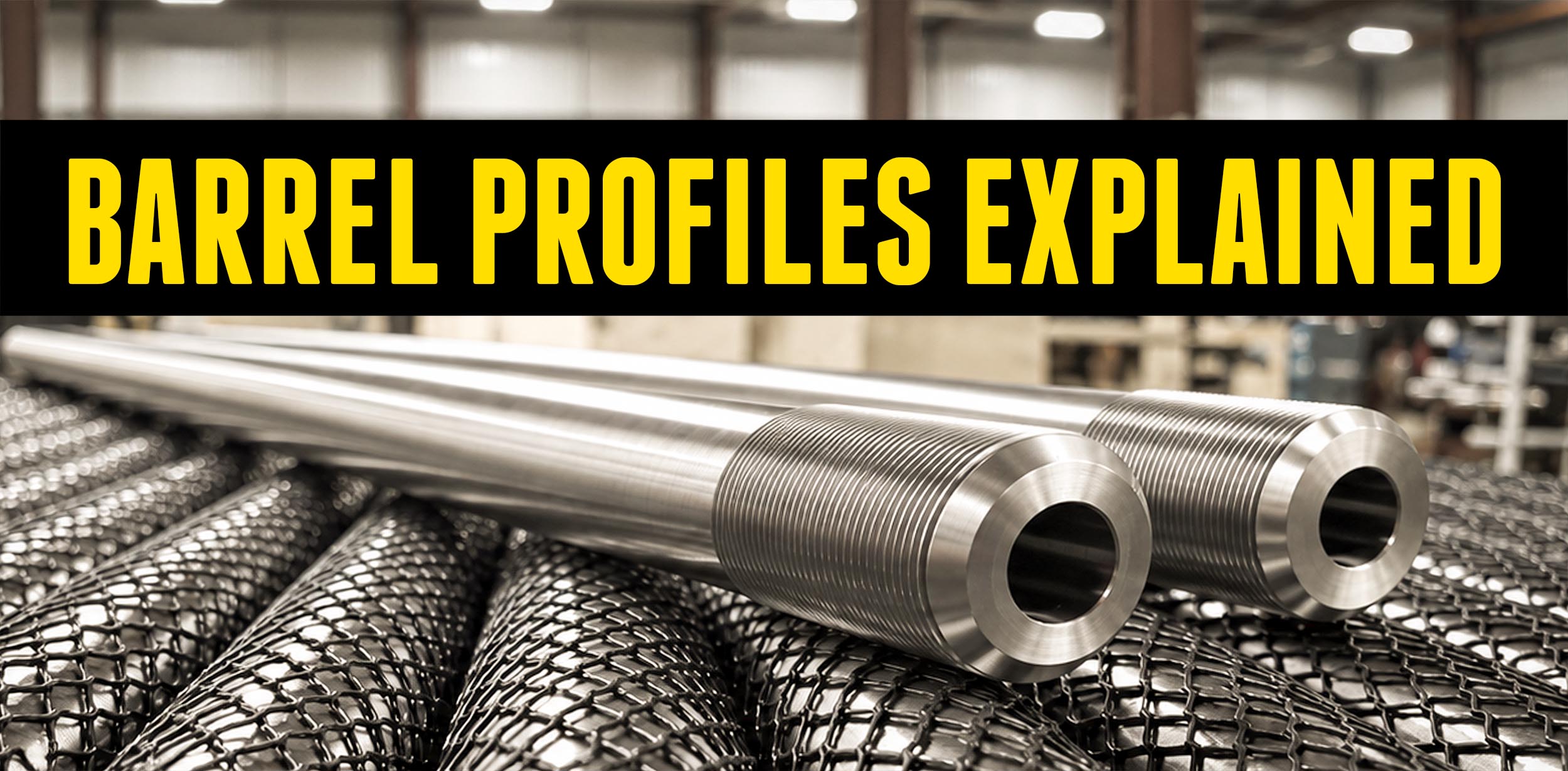
Rifle barrel profiles and contours can be completely frustrating, overwhelming, and intimidating. Recently, I had the opportunity to sit down with the team at Krieger Barrels to run through this exact topic. Every manufacturer has different profile categories and geometry, not to mention military guidelines and specifications that enter the big picture. In this video, we are going to demystify these profiles and discuss the critical factors you need to consider before ordering your next custom barrel blank.
Disclaimer
Ultimate Reloader LLC / Making with Metal Disclaimer: (by reading this article and/or watching video content you accept these terms). The content on this website (including videos, articles, ammunition reloading data, technical articles, gunsmithing and other information) is for demonstration purposes only. Do not attempt any of the processes or procedures shown or described on this website. All gunsmithing procedures should be carried out by a qualified and licensed gunsmith at their own risk. Do not attempt to repair or modify any firearms based on information on this website. Ultimate Reloader, LLC and Making With Metal can not be held liable for property or personal damage due to viewers/readers of this website performing activities, procedures, techniques, or practices described in whole or part on this website. By accepting these terms, you agree that you alone are solely responsible for your own safety and property as it pertains to activities, procedures, techniques, or practices described in whole or part on this website.
Key Considerations for Barrel Contours
Before you select a contour, you must understand how removing or leaving steel impacts the overall dynamics of your rifle. (Note that AR-15 and rimfire barrels have special considerations that are not covered here.)
- Weight and Rifle Balance: The contour you select dictates the center of gravity of your finished rifle. This drastically impacts how the rifle holds, points, and balances on barricades or bags.
- Stiffness and Harmonics: The more material you take off, the more “whippable” the end of the barrel becomes. Stiffness directly relates to barrel harmonics and point-of-impact shift. For maximum absolute accuracy, a straight contour (constant diameter) is ideal, but it comes with a massive weight penalty.
- Heat Capacity: This refers to the ability of the barrel to absorb heat as you shoot. If you are shooting a string of 5 to 10 shots, you want more thermal mass (a fatter profile) so the barrel doesn’t overheat and result in flyers.
- Shank Diameter and Stock Fitment (Barrel Channel): Your custom action threading dictates your minimum shank diameter (e.g., 1.062″ threads vs. 1.125″ Magnum threads). Furthermore, you must ensure your chosen profile will actually clear the barrel channel of your chassis or hunting stock. (Wood stock barrel channels can be modified.)
- Muzzle Threading (Diameter): To install a suppressor or brake, you need a minimum contact area (shoulder) at the muzzle. If you want a 5/8×24 thread pitch, your muzzle diameter must be thick enough to support it safely.
- Material: Some light barrel profiles are only available in chromoly, not stainless.
Point of Clarification: It’s important to understand the distinction between Straight Taper and Straight Contour.
Straight Taper: A changing diameter with no curvature (flat)
Straight Contour: Constant diameter from breech end to muzzle end
The Three Main Contour Families
To make things simple, we can break down the primary Krieger barrel profiles into three specific categories:
1. Sporter Contours
This is what you find on traditional big-game hunting rifles. A Sporter contour features a straight section at the shank, two curved transitions to the neck, and a straight taper to the muzzle.
Pros: Highly elegant appearance and minimal weight. Excellent for rifles you have to pack up and down a mountain.
Cons: They do not manage heat well during high-volume strings and can be incredibly difficult to thread for muzzle devices due to the thin muzzle diameter.
Specs: Typically 22″ to 26″ finished length, weighing between 2.0 and 4.5 lbs.
**Note: The Remington Varmint is currently catalogued as Palma contour with Krieger, though it was previously catalogued under Sporter contours.**
2. Varmint, Match, and Straight Contours
This category covers barrels with a cylindrical shank and a constant straight taper to the muzzle, or no taper at all (Straight Contour). This is where popular tactical profiles like the MTU or M24 Tactical live.
Pros: Incredible heat capacity, extreme rigidity, and highly consistent harmonics. Ideal for benchrest, PRS, and tactical applications.
Cons: Extremely heavy and difficult to carry in the field.
Specs: Lengths vary from 26″ up to 40″ (for ELR applications). Weights can range from 5.5 lbs all the way up to a staggering 32 lbs for a straight 2-inch .50 BMG blank.
3. Palma Contours
This introduces a third section to the geometry. You have an untapered shank, a straight taper transition down to a second diameter, and then a final straight section out to the muzzle.
Pros: Highly popular for competitive disciplines like Palma and PRS. It offers a fantastic middle-ground, balancing weight at the rear of the gun while maintaining enough rigidity at the muzzle.
Specs: These typically finish out at 30″ in length and weigh between 4.5 and 6.5 lbs. Palma contours are available in multiple calibers and can be finished to lengths other than 30 inches, which changes barrel cost.
**Note: The Remington Varmint is currently catalogued as Palma contour with Krieger, though it was previously catalogued under Sporter contours.**
Keep in mind that these are the three primary categories for rifle barrel profiles. There are always more variables and custom options like standard vs. 5R rifling, fluting, gain twist, etc..
Conclusion
At the end of the day, a barrel has a huge effect on rifle dynamics, and managing the trade-offs of your chosen contour is the name of the game. No one profile does it all. Less steel means it is easier to pack but less stiff; more steel means maximum rigidity and heat capacity, but a heavier rifle.
Krieger Barrels does top-tier work with their cut-rifled blanks, and they are always available to help you navigate these geometry options to ensure you succeed with your build. (Gordy Gritters is also a huge fan!)
Get the Gear
Shop barrels direct from Krieger.
Don’t miss out on Ultimate Reloader updates, make sure you’re subscribed!
Thanks,
Gavin Gear
About the author