
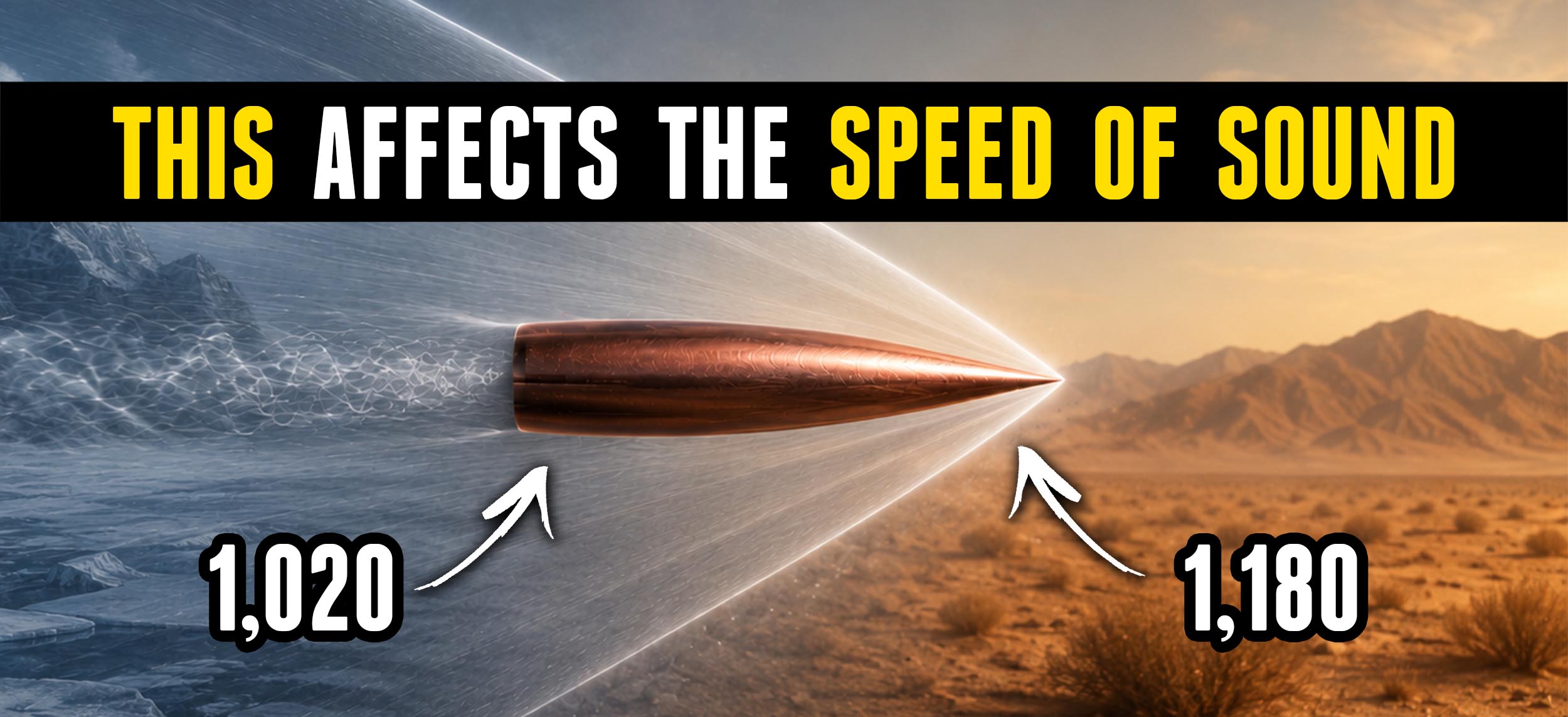
When any object breaks the speed of sound, it creates a concentration of sound energy. That’s why a supersonic rifle bullet cracks and a supersonic jet makes a sonic boom. In this article, I break those concepts down to an understandable level, with an emphasis on subsonic ammunition and the critical factors in the firearm, the ammunition and the shooting experience.
Disclaimer
Ultimate Reloader LLC / Making with Metal Disclaimer: (by reading this article and/or watching video content you accept these terms). The content on this website (including videos, articles, ammunition reloading data, technical articles, gunsmithing and other information) is for demonstration purposes only. Do not attempt any of the processes or procedures shown or described on this website. All gunsmithing procedures should be carried out by a qualified and licensed gunsmith at their own risk. Do not attempt to repair or modify any firearms based on information on this website. Ultimate Reloader, LLC and Making With Metal can not be held liable for property or personal damage due to viewers/readers of this website performing activities, procedures, techniques, or practices described in whole or part on this website. By accepting these terms, you agree that you alone are solely responsible for your own safety and property as it pertains to activities, procedures, techniques, or practices described in whole or part on this website.
Sources of Sound
Supersonic means faster than the speed of sound, and subsonic means staying under it. I recently learned some things that turned a few of my preconceived notions on their head.
When you fire a firearm, there are three sources of noise. First is the cycling of the action, which is most prominent with a semi-auto. Second is the muzzle report. Sound is made of pressure differentials, and the bigger the difference between pressure at the muzzle and atmospheric pressure as the bullet exits, the louder the boom.
Third, a supersonic bullet creates a cone of concentrated pressure off its front, and that creates the crack. Bryan Litz and his team at Applied Ballistics have specialty images that show the bullet’s trail and these supersonic pressure cones.
A suppressor’s entire purpose in life is to lower that pressure differential at the muzzle. Using a suppressor and keeping your ammunition subsonic is the magic combination for minimizing noise. Depending on your preferences, you may not even need hearing protection. I love shooting my suppressed 10/22 because it’s so quiet, and you can hear the steel targets getting hit a lot better.
Temperature and the Speed of Sound
Before studying this, I thought altitude was a major factor in the speed of sound. It turns out the speed of sound is primarily a function of temperature.
At sea level, if we could get the temperature down to -20°F (Alaska) and up to 120°F (Death Valley), the speed of sound would range from 1,028 fps to 1,181 fps. That’s a difference of 153 fps.
I also ran the numbers for sea level versus the summit of Mount Everest, and the speed of sound is, for all intents and purposes, the same. As you go up, pressure drops, but so does temperature, so they cancel out. The takeaway is that temperature has the biggest impact, and you need to think about it when planning where and how you’ll shoot subsonic ammunition.
Cartridges
When people hear “subsonic,” they usually think of rifle ammunition, since that’s where we obsess about it and create specialty cartridges. But in the handgun space, 9mm with a 147-grain bullet and 45 ACP with a 230-grain bullet are subsonic from standard handgun barrel lengths. You essentially get subsonic for free. There are exceptions with lighter bullets, but many handgun cartridges are subsonic.
Some cartridges are designed to be both subsonic and supersonic, and 300 Blackout is the best example. With heavy-for-caliber 220-grain bullets, it’s cleanly subsonic. Drop to a lighter bullet like a 175-grain, and you can hypothetically run supersonic ammunition from the same AR-15 without changing the suppressor, gas port, buffer weight or buffer spring. One weapon, multiple scenarios: supersonic for longer range and subsonic for a close-quarters tactical advantage.
Then there are specialty scenarios. Two of our favorites at Ultimate Reloader are subsonic 308 Winchester and subsonic 30-30. Neither is intended to be subsonic, but both can be loaded that way, and it’s super easy in a bolt action.
Velocity Targets
With a rifle, you usually want maximum energy, so the goal is to get as close to the speed of sound, usually around 1,100 fps, as you can with enough buffer to make sure no round goes supersonic.
Several things can push velocity around. Sometimes the first round through a suppressed firearm has a different velocity. Temperature changes the speed of sound itself, and if you have a temperature-sensitive powder, hot weather can spike your velocity enough to carry you over.
Based on my conversations with Hodgdon, the typical advice is to run about 1,050 fps. With a hypothetical extreme spread of 40 fps, you’d be roughly 20 fps high and 20 fps low. That gives you a safety margin so you’re reasonably certain every round is subsonic, while keeping velocity as high as possible.
For handguns like the 45 ACP with a 230-grain bullet or 9mm with a 147-grain bullet, you might be down around 800 fps, which is pretty much right where those bullet weights land. Whether you’re shooting factory ammo or reloads, you’ll want a chronograph to actually capture this.
Semi-Auto Complexity
Things get really complicated with semi-autos, which are incredibly popular with subsonic ammunition. Here are the variables that affect a semi-auto handgun or rifle with subsonic ammo:
- Operating system: Direct impingement like the AR-15, a piston system like the AK-47, or blowback like a Glock. Each behaves differently and has different tuning parameters.
- System length: A full-size Glock is more forgiving than a compact, and an AR-15’s gas system length directly affects cycling and reliability. Generally, the shorter the system, the more particular it is about the load.
- Suppressor design: Suppressors increase gas in an AR, which can help subsonic ammo cycle. But an overcaliber suppressor, like a 45-caliber can on a 223, has excessive clearance that changes both pressure dynamics and noise reduction. Newer flow-forward cans behave differently again.
- Ammunition: The consistency of the burn and velocity, especially extreme spread.
- Tuning parameters: Buffer weight, spring stiffness, and gas port diameter or adjustable gas setting.
Suppressors are more sensitive to excessive clearance than muzzle brakes. In one of our experiments, a brake’s recoil reduction was barely affected until clearance reached about 0.1″ to 0.2″, which surprised me. With suppressors, huge clearances make sound reduction less effective.
For long-range precision, we usually care most about standard deviation. With subsonic ammo, extreme spread matters more, because we’re worried about the one outlier that goes supersonic. And as charge weights come down, the burn can inherently become less stable, which makes powder choice really important.
This is a complicated problem domain, and if you like solving problems, it’s the right place to be.
Powder Selection
Powder selection is one of the most important parts of loading subsonic ammunition, and I’ve learned some really interesting things talking with the team at Hodgdon.
For pistol shooters, the normal powders that work well in an unsuppressed handgun will likely work really well in a suppressed one too. Hodgdon’s 45 ACP data for a 230-grain bullet lists a whole bunch of powders. We typically use CFE Pistol, which I like for its copper fouling reduction and good performance, and it ranges from 816 to 942 fps. For 9mm with a 147-grain bullet, Hodgdon lists CFE Pistol at 862 to 925 fps. Both are very comfortably subsonic.
Rifle is much more particular. Hodgdon has subsonic-specific load data, which is awesome, because they’ve done the testing and give both accurate data and powder recommendations. There’s also a separate reduced recoil section, which sometimes overlaps with subsonic.
I think of subsonic rifle powders three ways. There are magnum pistol powders like H110, which we use all the time, including for 300 Blackout. There are subsonic-designed powders like CFE BLK, which also works well for other applications at that burn rate.
Then there are specialty powders, and for specialty applications, Titegroup is the clear winner. It’s extremely versatile and position-insensitive. With lots of air space in the case, it doesn’t matter whether the primer flash hits the powder directly or hits air. That comes down to the powder’s burning characteristics, which, like burn rate, are relative to a specific operating environment. Titegroup is a low-charge-weight pistol powder, but it turns out to be the clear winner for specialty subsonic rifle loads. More on that in future videos.
Bullet Selection
For rifle, the theme is extremely heavy-for-caliber bullets. A standard 308 Winchester bullet weight is probably around 168 grains. For subsonic, we’re up around 220 grains, anywhere from about 190 to 250. That takes up more internal case volume, but we don’t need as much powder, so it works together.
Pay careful attention to your magazines. These bullets can have difficult profiles, like an abrupt flat point instead of a sharp point, as this Hornady 300 Blackout ammo shows. That’s why there are AR-15 magazines designed specifically for 300 Blackout.]
For hunting and defense, there are bullets specifically designed to carry energy, expand properly and deliver the right terminal ballistics at subsonic velocities. Options range from mild to wild on price. Conventional jacketed heavy-for-caliber bullets are really expensive, but Berry’s Manufacturing offers a bunch of economical options tailored for these loads.
Conclusion
First, think critically about the firearm and suppressor you’ll use, because they greatly impact your experience. My KS-47 in 7.62×39 is very picky with subsonic loads. But a full-size AK-47 with Berry’s 220-grain bullets is like a garbage disposal. It’s piston driven, it’s a long platform and it’s very forgiving.
Second, load or select the right ammunition. Not every subsonic ammo SKU will work well in your firearm, so test before buying or loading in bulk to make sure your velocity is right and consistent enough. Reduced loads can get erratic, and that’s where powder selection becomes really important.
Finally, if you have tuning options, like on an AR-15, use them. Open or close an adjustable gas port, experiment with buffer springs, and work all the variables, ideally one at a time, until you settle on something reliable that meets your goals.
This is just the start. My next story on this topic will cover how to use Hodgdon’s subsonic load data, plus what data to capture and how to interpret it while developing and testing your loads.
Get the Gear
Search the subsonic section of Hodgdon’s Reloading Data Center.
Don’t miss out on Ultimate Reloader updates, make sure you’re subscribed!
Thanks,
Gavin Gear
About the author