
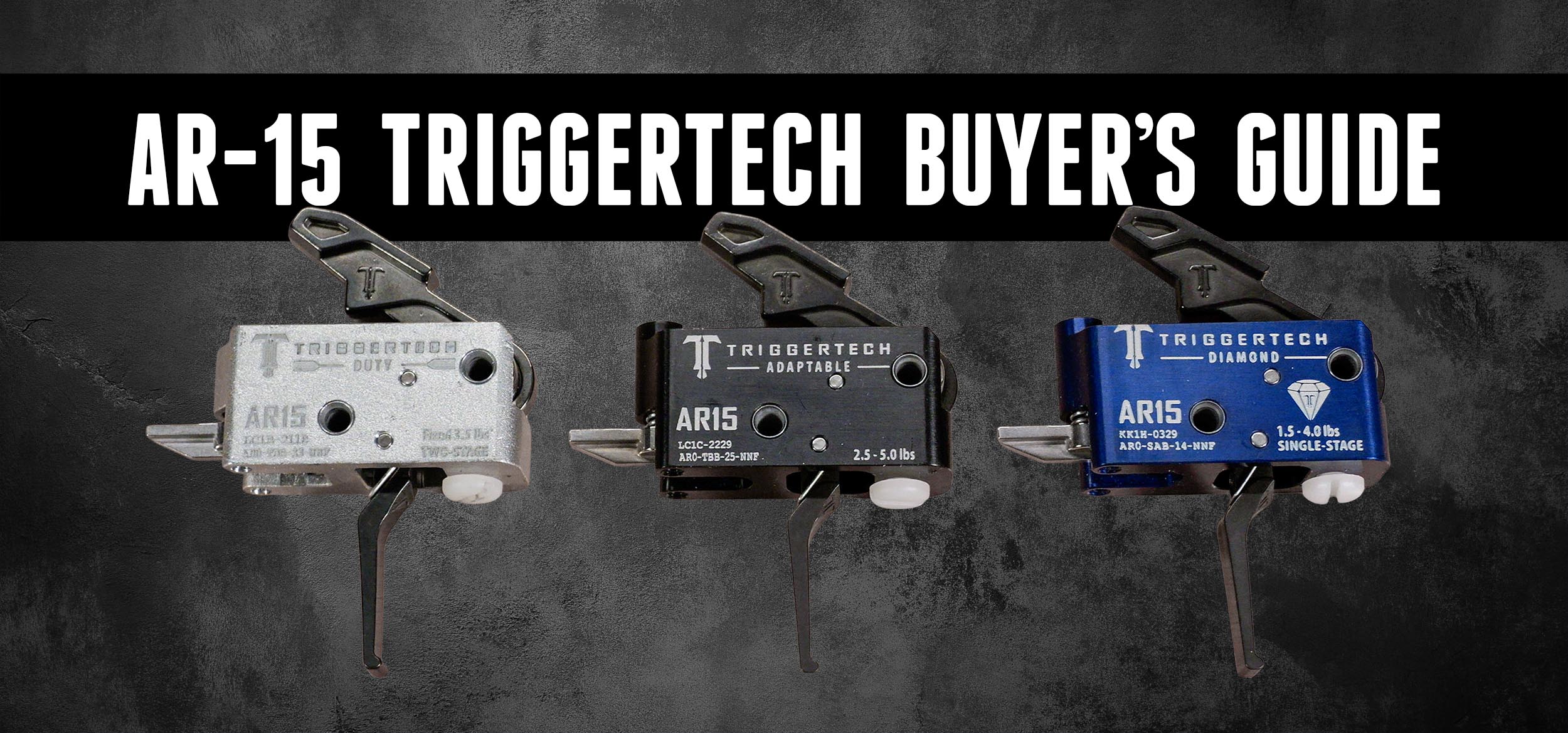
We use TriggerTech triggers all the time on the Remington 700 platform, but this time I’m looking at TriggerTech’s AR-15 triggers instead. I tested three drop-in triggers on the TriggerScan to see how they compare.
Disclaimer
Ultimate Reloader LLC / Making with Metal Disclaimer: (by reading this article and/or watching video content you accept these terms). The content on this website (including videos, articles, ammunition reloading data, technical articles, gunsmithing and other information) is for demonstration purposes only. Do not attempt any of the processes or procedures shown or described on this website. All gunsmithing procedures should be carried out by a qualified and licensed gunsmith at their own risk. Do not attempt to repair or modify any firearms based on information on this website. Articles on this website are derived from original video content and may utilize artificial intelligence (AI) tools for initial drafting, transcript processing, and editorial refinement; no AI technology independently generates or verifies technical instructions or safety data. Ultimate Reloader, LLC and Making With Metal can not be held liable for property or personal damage due to viewers/readers of this website performing activities, procedures, techniques, or practices described in whole or part on this website. By accepting these terms, you agree that you alone are solely responsible for your own safety and property as it pertains to activities, procedures, techniques, or practices described in whole or part on this website.
About TriggerTech AR-15 Triggers
Gavin and I recently covered TriggerTech’s single-stage Remington 700 triggers, and a two-stage follow-up is coming soon. For the AR-15, I tested two two-stage triggers, the Duty and the Adaptable, plus the single-stage Diamond.
The anatomy is very similar to TriggerTech’s Remington 700 triggers. A free-floating roller replaces the sliding contact between mating surfaces found in traditional triggers, reducing friction. That gives a very clean break with zero creep. You can tell exactly when it’s going to break, which is a big difference from the gritty factory triggers often found in ARs.
Gavin also covered the Diamond two-stage AR-15 trigger a while back, including installation, if you want more detail on that model.
TriggerTech Duty
The Duty is TriggerTech’s affordable AR-15 trigger, and I was quite surprised by it. It honestly makes me want to replace the trigger in my personal AR.
- Two-stage
- Fixed pull weight: 3.5 lb or 5.5 lb
- Typical use: military, law enforcement and 3-Gun
- Lever options: traditional curved or straight flat
- MSRP: $139.99
We tested the 3.5-pound version with a straight flat lever. Without a pull gauge, I wouldn’t have guessed it was that weight; it was that clean. On the TriggerScan, it showed a nice long take-up followed by a very clean, consistent break at about 3.7 pounds. All three pulls lined up almost dead on.
TriggerTech Adaptable
The Adaptable is the middle of the line. It’s also a two-stage trigger, but you can adjust the pull weight.
- Two-stage
- Adjustable pull weight: 2.5 to 5 lb
- Typical use: 3-Gun competition and precision shooting
- Lever options: PVD black flat, PVD black curved, stainless steel curved, stainless steel flat
- MSRP: $284.99
I’m a fan of flat triggers, especially on an AR, so that’s what I’d pick. Adjustment is very easy. Once you break open the upper and lower and lift the upper, there’s a click-adjustable set screw right on top of the trigger.
On the TriggerScan, the Adaptable measured 2.6 pounds at minimum, about 3.5 pounds at medium and 5.1 pounds at maximum. That’s right where we expected, and all the pulls lined up very consistently.
TriggerTech Diamond
The Diamond single-stage is the top of the line.
- Single-stage
- Adjustable pull weight: 1.5 to 4.0 lb
- Typical use: competition, long range and precision shooting
- Lever options: PVD black Pro Curved, PVD black flat
- MSRP: $324.99
The TriggerScan showed 1.5 pounds dead on at minimum, about 2.5 pounds at medium and 4.0 pounds at maximum. Again, the results were very consistent.
Installation
Installation is very easy. I’m pretty familiar with ARs and only needed to skim the directions. Remove the factory trigger or previous drop-in, along with the safety and grip, push the pins out, and drop in the TriggerTech. Snug the set screws on the housing, adjust the trigger as needed, then put the upper back on and push the pin in.
TriggerTech’s instructions are very good and easy to follow. For a detailed walkthrough, check out Gavin’s Diamond two-stage video.
Conclusion
TriggerTech offers a trigger for just about every application: curved or flat, PVD or not, single-stage or two-stage. Even on a budget, the Duty is a great way to get your foot in the door with TriggerTech, and for most people, it’s going to fit just fine as an all-arounder.
Every one of these is a massive improvement over a mil-spec trigger. There are more affordable non-drop-in options, but I don’t like messing with springs and all the fiddliness that comes with them. I much prefer a drop-in: set it and forget it.
Get the Gear
Shop all TriggerTech AR-15 triggers here!
Don’t miss out on Ultimate Reloader updates, make sure you’re subscribed!
Thanks,
Kyle Shields
About the author