
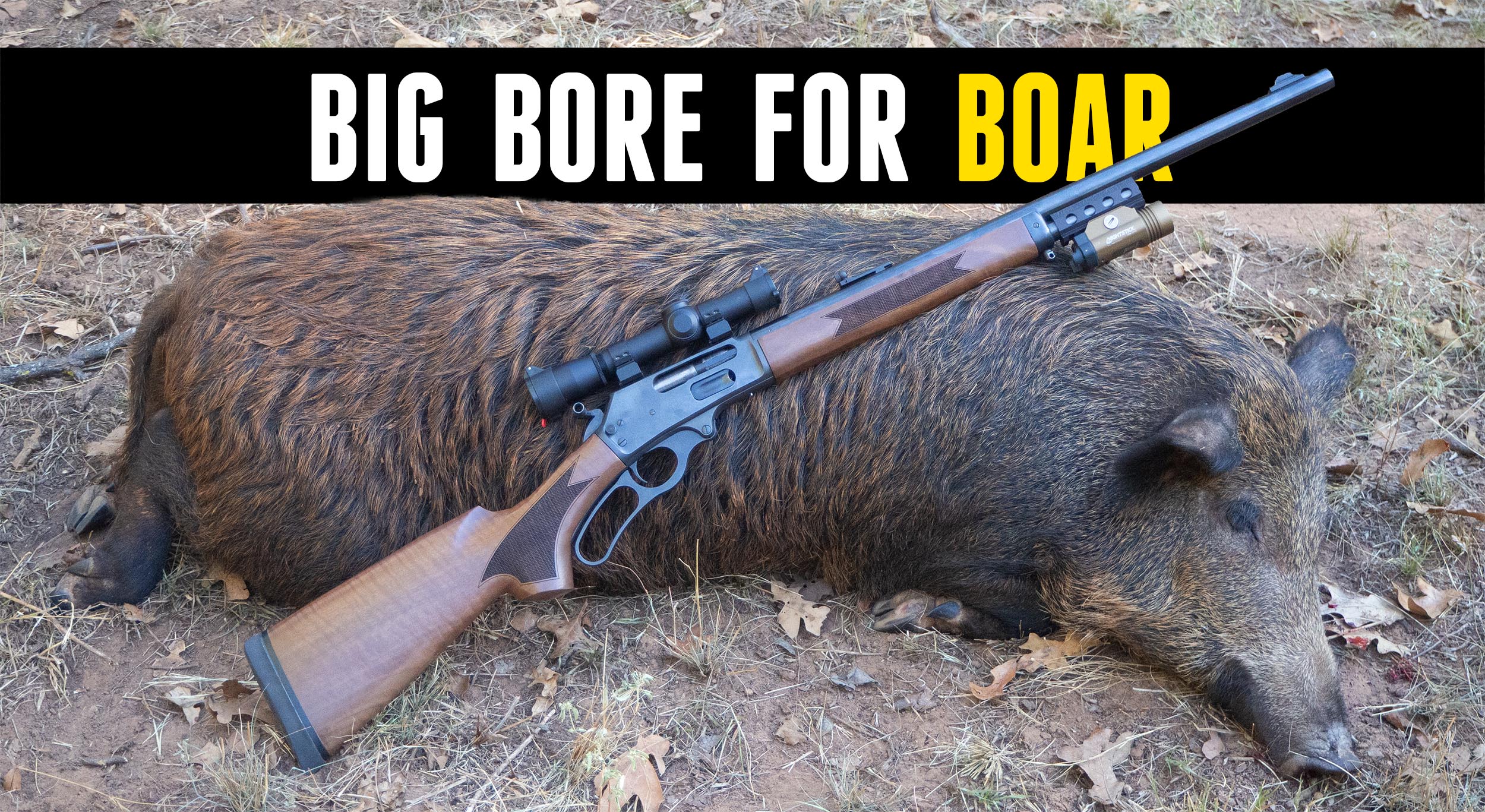
Last fall I had the chance to take a couple of wild hogs here in Oklahoma using big bore Hornady bullets, one with a single action revolver, the other with a lever action rifle.
Hogs are an invasive species, not native to North America but they’ve sure made themselves at home here. Their population is estimated to be as many as nine million, and they’re terribly destructive to farmland and natural habitat.The first swine were brought to America in the 1500’s as a food source. Hunting in many areas is encouraged, with no closed season and no limit. Hunters have long sought wild hogs as a food source. These days they’re also killed simply to reduce their population.
Disclaimer
Ultimate Reloader LLC / Making with Metal Disclaimer: (by reading this article and/or watching video content you accept these terms). The content on this website (including videos, articles, ammunition reloading data, technical articles, gunsmithing and other information) is for demonstration purposes only. Do not attempt any of the processes or procedures shown or described on this website. All gunsmithing procedures should be carried out by a qualified and licensed gunsmith at their own risk. Do not attempt to repair or modify any firearms based on information on this website. Ultimate Reloader, LLC and Making With Metal can not be held liable for property or personal damage due to viewers/readers of this website performing activities, procedures, techniques, or practices described in whole or part on this website. By accepting these terms, you agree that you alone are solely responsible for your own safety and property as it pertains to activities, procedures, techniques, or practices described in whole or part on this website.
Revolvers and 44 Magnum
Revolvers are special to me, I’ve always enjoyed shooting them and handloading the cartridges. This fine Ruger came from the collection of Bob Baer, a noted gunsmith and revolver aficionado. Ruger built this Super Blackhawk Bisley Hunter in 2003. I was fortunate enough to pick it up about two years ago and have been working up loads and practicing with it ever since. This model is an adaptation of the well established Super Blackhawk, enhanced for hunting. The Bisley grip deals well with recoil from stout loads. The barrel is ribbed, adding more weight forward and is also scalloped to accept Ruger’s scope rings. I topped it with a 30mm UltraDot red-dot sight and zeroed it at 50 yards. Rugers are capable of handling very stout 44 magnum loads.
I’ve been loading and shooting the 44 magnum since the mid 1980’s when I had a 7.5” Super Blackhawk. Since then I’ve owned a couple more Rugers and several Smith and Wesson 629’s. All have been good revolvers. Lever action carbines can also be chambered in 44 magnum, and add a few hundred fps to the muzzle velocity. A 44 magnum is not required for taking wild hogs, any number of handgun cartridges are suitable, but I do like the 44 from a big revolver.
Loading the 44 Magnum
I chose components well known to me, Accurate No. 9 and Hornady’s 240 grain XTP bullets along with Winchester Large Pistol primers. Everything was assembled on RCBS gear, using the single-stage Summit press and my old RCBS dies from the 1980’s.
Hodgdon’s data shows a maximum load of 20.5 grains and I topped off my load with a half grain less than that. I’ve used Accurate No. 9 for a long time now in several magnum revolvers. Like other spherical powders Accurate No. 9 flows very well and consistently through a manually operated powder measure. My 7.5” revolver averaged just under 1350 fps and was comfortable to shoot as well as being quite accurate.
I used my standard 40 year old RCBS dies for the entire process though I did not size the cases as I was using brand new brass. Flaring the case mouth is vital with lead bullets to prevent the case mouth from shaving lead off the bullet. It also helps with jacketed bullets. I seated and crimped the rounds in two separate steps though they can be combined into a single step. All priming for the 44 and the 45-70 was done with the RCBS universal hand primer.
Hornady recommends a wide range of 44 caliber bullets for hunting. They range from a light 180 grain bullet up to the tough 300 grain XTP which we’ve tested for penetration and expansion previously. Over the years 240-250 grain bullets have become accepted as standard for the 44 magnum and have handled many different hunting situations well. I chose the well proven 240 grain XTP for this hunt.
Hornady’s XTP has a well-defined cannelure in which to crimp the case. I’ve always found these bullets to be accurate and this time was no exception as I was able to keep most of my shots in a tight group at 50 yards. The XTP is known as a “tough” expanding bullet which tends to penetrate very well. The XTP line is well respected by handgun hunters wanting an expanding bullet that also penetrates well and offers great accuracy.
About the Rifle
Marlin’s 1895, built by Marlin, Remington and currently by Ruger, is probably the most popular lever action 45-70 rifle. It’s strong, reliable, typically quite accurate, handles well and there are a lot of different accessories available to personalize it. Mine was built by Remington and has a 22” barrel. We upgraded the stocks with attractive walnut stocks from Boyd’s.
I like using a lightweight low power scope on my lever action rifles. This is the discontinued 2.5x Leupold, mounted in quick release rings. Today I’d likely choose Leupold’s 1.5-4x or their 1.5-5x for the rifle. For hunting in low light a scope with a larger objective would help make best use of the available light.
The factory Marlin sights are serviceable, however I strongly prefer an aperture sight. Among their many offerings Skinner includes a barrel mounted aperture sight. Aperture sights are normally mounted on the receiver, but this works out very well and compliments the quick detach scope. The factory front sight was also replaced with a Skinner “Bear Buster.”
Finally I used the Wild West Guns light mount and a very bright Nightstick weapons light. This rifle often accompanies me on backcountry camping, fishing, hiking and hunting trips. It’s comforting to have along in bear country, particularly with the attached light.
About the 45-70
The wonderful old 45-70 was nearly dead when Marlin breathed new life into it with the introduction of their 1895, and suddenly the popularity of the old cartridge greatly increased. Movies like Jurassic Park and Wind River also featured the 45-70 Marlin, and further popularized it.
Some guides carry the 1895 for bear defense. When my 8’ grizzly showed up at less than 50 yards I really wished that I’d had my stout-loaded Marlin lever action 45-70 instead of my bolt action 30-06 rifle. A lot of shooting happened in a hurry at short range and that fast shooting lever gun heaving big bullets may have been a better choice at that point.
Hornady has a great lineup of hunting bullets intended specifically for lever action 45-70 rifles. The 250 grain MonoFlex is a great choice for hunting in California where bullets containing lead are outlawed for hunting. The 300 grain hollow point is a standard choice for many deer hunters and a hunting partner of mine took a good black bear with one shot at about 60 yards. Their 325 grain FTX bullet provides a somewhat higher ballistic coefficient and rapid expansion. Both the flat nose and the round nose 350 grain bullets appeal to me and I’ve used them both. The recently introduced 410 grain Sub-X bullet performs well up to about 1600 fps according to Hornady. We’ve tested it in subsonic and supersonic loads. It’s one heck of a bullet!
This time proven bullet feeds very well through my rifle and has proven accurate. Until now though, I’d never taken game with it. It’s an InterLock bullet, meaning that a mechanical ridge on the inside of the jacket locks the lead core to the jacket. I also noticed that there are very light skives cut into the jacket nose to enhance expansion. Hornady continues to produce these traditional round nose bullets in several different calibers because they continue to deliver exemplary performance on game and there’s a good market for them despite the trend towards high BC long range rifle bullets. They work very well in their intended application.
Loading the 45-70
Several years ago I came up with a bear defense 45-70 load using Hornady’s 350 grain Round Nose Interlock bullet. This load is slightly above Hornady’s recommended loads for lever action rifles, but is listed as a starting load for lever actions by Hodgdon. I’ve shot a couple of hundred of these through my rifle with no adverse impact on the rifle. My shoulder starts complaining if I shoot too many of them though!
Many different powders are suitable for the 45-70 cartridge. I’ve been using mostly IMR 3031 in recent years and it’s been providing excellent accuracy and velocity. A 45 caliber, 350 grain soft nose bullet at 2060 fps is no joke! That’s roughly the velocity I see from a 30-30 with 170 grain handloads.
Anticipating a maximum range of about 50 yards, I zeroed both the revolver and the rifle at that range. The revolver drops about four inches at 100 yards while the rifle only loses about an inch at that range. Both are powerful loads but accurate and not particularly difficult to handle. The thickly wooded nature of the terrain at Hog Wild makes shots beyond 50 yards quite rare.
To try out these two Hornady bullets I took advantage of a nearby high fence operation, Hog Wild about an hour south of Oklahoma City. It’s an impressive place, well laid out for guests. Matt, the owner, has been running the place for 14 years and has many satisfied customers. He seeks to provide a fun, safe and rewarding experience for anyone wanting to shoot hogs or other exotic animals. Disabled hunters, older hunters and young hunters can all be accommodated. The terrain is cut by some deep ravines and is thickly wooded. Shots over 50 yards are rare.
In the Northwest and Alaska I’ve done wilderness hunts over a week long by backpack or in the saddle, then walking. They’re awesome, but there are times when a less arduous experience is welcome.
Hog Wild offers two different styles of hunting, from a blind or by spot and stalk. I opted to hunt from a blind in the morning, with my revolver. Later, accompanied by guide Colton I went back afield with my rifle to collect a second hog.
Matt cautions his clients that hogs can be difficult to bring down and recommends a brain shot if possible. That results in instant death and no tracking. If a body shot is taken he instructs clients to shoot ⅓ to ½ way up the body, just above the front leg. This should put the bullet in the heart-lung area and lead to a short tracking job. He is pleased when handgun hunters elect to hunt from the blind, utilizing a rest for stability. There are ledges inside the blind’s windows which provide a great place to put a sandbag or other type of rest.
The place is very well set up to take care of downed game. My hogs were skinned and the meat on ice within a few minutes of arriving at the skinning room. Hog Wild is affordable, interesting, located near a major airport and easy to find. There’s a comfortable lodge as well. More details can be found at their website: Oklahoma Wild Boar Hog Hunting | Hog Wild
The Hunt
Matt drove me to one of their blinds before sunrise. Nearby is an automated game feeder to attract hogs and other game. I climbed into the well constructed Redneck blind and settled in quietly, with my old leather bunny-ear bag just inside the window. Range to the feeder was only about 30 yards. Shortly after Matt left in his side by side I could hear movement below, near the feeder. As the daylight increased I could make out an impressive bull elk and a cow elk as well. Nearby were four hogs, three smaller ones and a big one, but I thought it was still too dark to shoot.
The big bull left first, followed shortly afterwards by the cow elk. The hogs then had free run at the grain which had been dispensed by the feeder. I watched them intently, waiting for more light. Suddenly they left the area! Roughly 20 minutes later a young boar arrived alone and began feeding. I watched him for a bit, then decided that he’d likely provide very good meat.
The red dot was just slightly behind his left fore-leg when I pressed the Ruger’s trigger. The gun barked and I saw the pig hunch up then run off out of sight to the left. I could hear him run through the dry leaves for just a few seconds, then silence. I knew my pig was down. Guide Colton showed up and we followed the ample blood trail to a fallen hog about 40 yards from where I’d shot him. The bullet had gone completely through the small pig, which didn’t surprise me in the least. After a couple of photos we headed back to the lodge and the skinning room. I’d brought a couple of coolers, and Hog Wild has a large and busy ice machine adjacent to the skinning area. The meat was on ice within minutes, then Colton and I headed out for the second hog.
I was looking forward to using the Marlin. It had been quite a few years since I’d last taken game with the 45-70, a muley doe that time.
Soon we found a sounder of hogs and started a stalk. Hogs have excellent senses of hearing and smell but poor eyesight. They detected us and moved off, but they weren’t panicked and didn’t go far. We closed again, and bumped into three or four that we hadn’t seen! They ran too quickly for me to get a shot. They ran to the rest of the group, which also ran… but again they didn’t go far.
We knelt and watched. By getting low, we could see under most of the tree branches, yet above the grasses and downed tree limbs. The pigs started moving from left to right across our front, and quartering towards us a bit. I found a window in the brush, which I focused on, hoping that one of the larger hogs would offer me a shot while in that more open area about 35 yards from us.
The hogs started heading through the open area and suddenly one sow was by herself, standing still and slightly quartering towards us. From my kneeling position I fired. The Marlin roared and she dropped in place instantly! I’d targeted the area where the neck and shoulder join, hoping to get the bullet into one of the lungs and/or break a shoulder. I chambered another round quickly, and after watching for a few minutes we approached. She was still and lifeless and a good sized eating hog. Exactly what my wife and I had hoped I’d get!
Together we lifted the hog into the side by side then drove back to the lodge to skin this one as well. Colton handled the skinning chores expertly and found the expanded bullet just under the hide where it had stopped after penetrating about two feet through her. Later I weighed and measured the bullet. It had expanded tremendously to over .9” and weighed 309 grains, or about 88% of the original weight. That Interlock ring seems to have worked well at retaining the lead. I was impressed with the weight retention, the expansion and the penetration of that bullet.
The meat looked great! It’s going to be used as pork roasts and breakfast sausage.
Conclusion
My purpose was to use two different big-bore Hornady bullets on game and to procure some excellent pork for my family. Both of those things were achieved in short order.
These traditional Hornady bullets each performed well. The .430” 240 grain XTP upheld its reputation for accuracy and good penetration. This bullet is a popular choice for handgun hunters and deservedly so.
The .458” 350 grain InterLock also shot very well at the range, and produced instant results afield. The expansion, weight retention and penetration were all quite good. I had wondered how much expansion I’d see from the bullet and it surprised me a bit by expanding so much.
There are many good choices for 44 magnum and 45-70 hunting bullets. Hornady has long produced some excellent options.
For anyone seeking a fun and quick hog hunting adventure, I recommend checking out Hog Wild in Oklahoma.
Get the Gear
RCBS Summit Single Stage Reloading Press
Accessory Base Plate-3 by RCBS
45-70 Government Full Length Roll Crimp 3 Die Set by RCBS
44 Mag/44 Special Carbide Roll Crimp 3 Die Set by RCBS
Uniflow Powder Measure III by RCBS
Universal Hand Priming Tool by RCBS
IMR 3031 Smokeless Powder (1 lb) by IMR
Accurate No. 9 Smokeless Powder (1 lb) by Accurate
45 Caliber .458 Diameter 350 Grain Round Nose With Cannelure 50 Count by Hornady
44 Caliber .430 Diameter 240 Grain XTP With Cannelure 100 Count by Hornady
45-70 Govt Unprimed Rifle Brass 50 Count by Hornady
44 Magnum Unprimed Pistol Brass 100 Count by Hornady
Winchester Large Pistol Primers 1000 Count by Winchester
Oklahoma Wild Boar Hog Hunting | Hog Wild
Don’t miss out on Ultimate Reloader updates, make sure you’re subscribed!
Thanks,
Guy Miner
About the author