
I recently had the incredible opportunity to travel to Hornady headquarters in Grand Island, Nebraska, and go underground into their state-of-the-art 200-yard testing facility. In this video, I sit down with Assistant Director of Engineering Joe Tan to get a behind-the-scenes look at exactly how Hornady tests their component bullets straight off the production line to ensure they meet strict accuracy standards.
Disclaimer
Ultimate Reloader LLC / Making with Metal Disclaimer: (by reading this article and/or watching video content you accept these terms). The content on this website (including videos, articles, ammunition reloading data, technical articles, gunsmithing and other information) is for demonstration purposes only. Do not attempt any of the processes or procedures shown or described on this website. All gunsmithing procedures should be carried out by a qualified and licensed gunsmith at their own risk. Do not attempt to repair or modify any firearms based on information on this website. Ultimate Reloader, LLC and Making With Metal can not be held liable for property or personal damage due to viewers/readers of this website performing activities, procedures, techniques, or practices described in whole or part on this website. By accepting these terms, you agree that you alone are solely responsible for your own safety and property as it pertains to activities, procedures, techniques, or practices described in whole or part on this website.
A Culture of Rigorous Testing
Hornady takes their quality control incredibly seriously. Upstairs from the 200-yard accuracy range, they conduct exhaustive terminal performance testing. This includes rigorous FBI-protocol ballistic gelatin and barrier testing for law enforcement ammunition like their 9mm Critical Duty, as well as testing wax mediums for heavy dangerous game hunting projectiles like the CX bullet line.
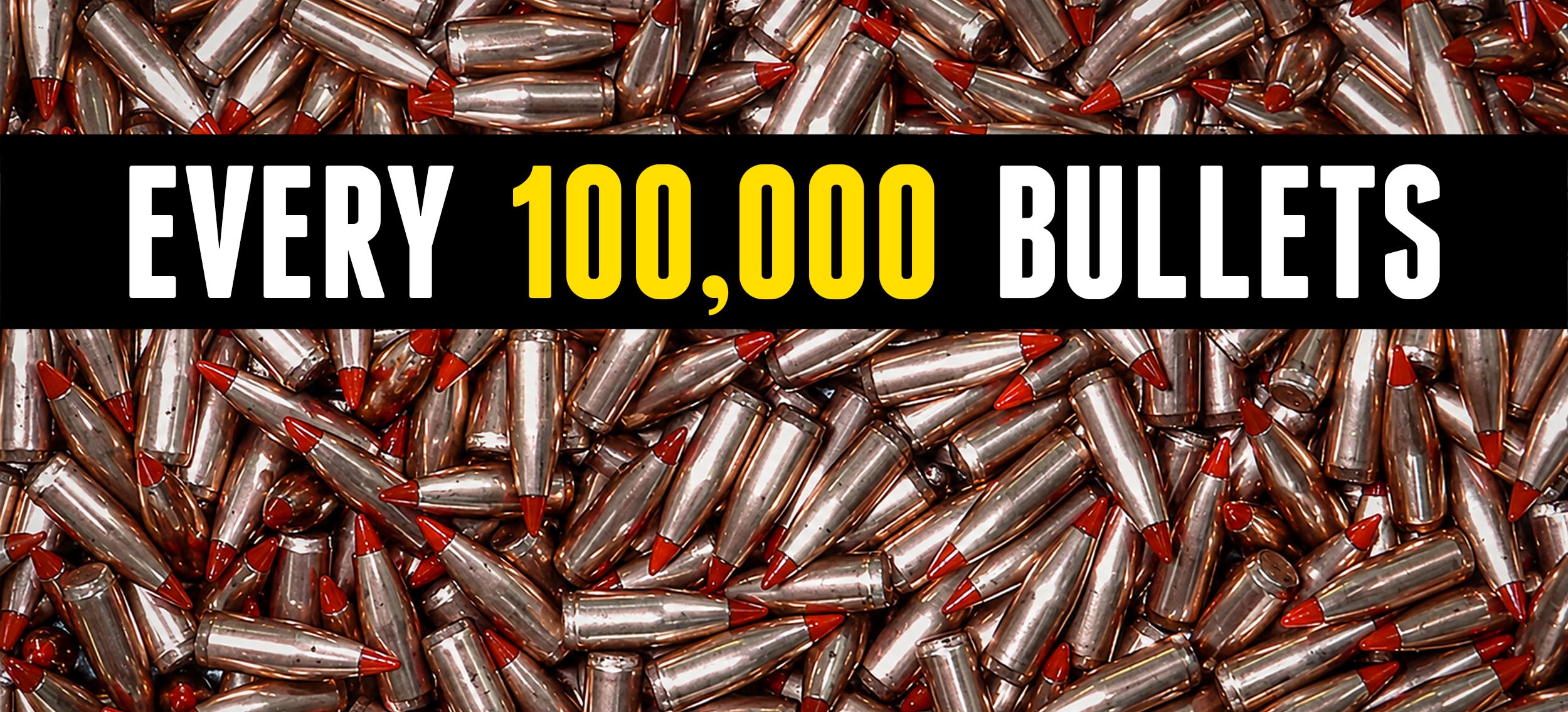
Down in the underground tube, the focus shifts to pure precision. Every time a bullet press produces 100,000 projectiles (roughly every two and a half days of continuous operation), a sample is pulled and sent to this underground lab for a pass/fail accuracy test.
Loading the Test Ammunition
For this demonstration, Joe put me to work testing a fresh lot of 6.5mm 147-grain ELD-M (Match) bullets.
Hornady tests these bullets exactly how a consumer would use them. We didn’t use a wildcat cartridge; we loaded standard 6.5 Creedmoor. Using a Hornady Classic Pro single-stage press, I charged the cases with 39.0 grains of H4350 powder and seated the 147-grain ELD-Ms to a nominal overall length of 2.835 inches. Consistency is the name of the game here—loading them the same way every single time ensures a valid quality control baseline.
The Test Fixture and Barrels
To eliminate as many variables as possible, Hornady uses top-tier equipment for the firing process.
The test rifle consisted of a heavy 737 action mated to a Bartlein 5R 1:8 twist single-point cut rifle barrel. Hornady controls their own reamers and chambers these barrels in-house. To simulate what a customer will experience in the real world, they cut the SAAMI-spec chambers to sit roughly one to three thousandths over a GO gauge, providing realistic tolerances rather than an absolute minimum match fit.
The barreled action is locked into a proprietary return-to-battery V-block fixture designed and machined by Hornady. This fixture is incredibly robust, riding on linear bearings and returning to the exact same position within a tenth of a thousandth of an inch shot after shot.
The 200-Yard Accuracy Standard
The test criteria for long-range match bullets like the A-Tip, BTHP, and ELD-M is incredibly strict: a 10-shot group must measure 1 inch or less at 200 yards (sub-half MOA).
The test fixture fires down the 200-yard underground tube through an Oehler electronic target system. After firing two initial fouler shots to settle the barrel, I ran the remaining 10 test rounds. The result? The 12-shot total group measured an outstanding 0.830 inches at 200 yards, boasting a mean radius of just 0.280 inches. This indicates the bullets were clustering tightly in the center, easily passing the test and giving the press operator the green light to continue production.
Conclusion
It is incredibly reassuring to see the lengths Hornady goes to in order to ensure their projectiles perform to the gold standard of precision shooting. Testing real-world loads in top-tier cut-rifled barrels guarantees that when you open a red box on your reloading bench, the consistency is built in.
Get the Gear
Don’t miss out on Ultimate Reloader updates, make sure you’re subscribed!
Thanks,
Gavin Gear
About the author