
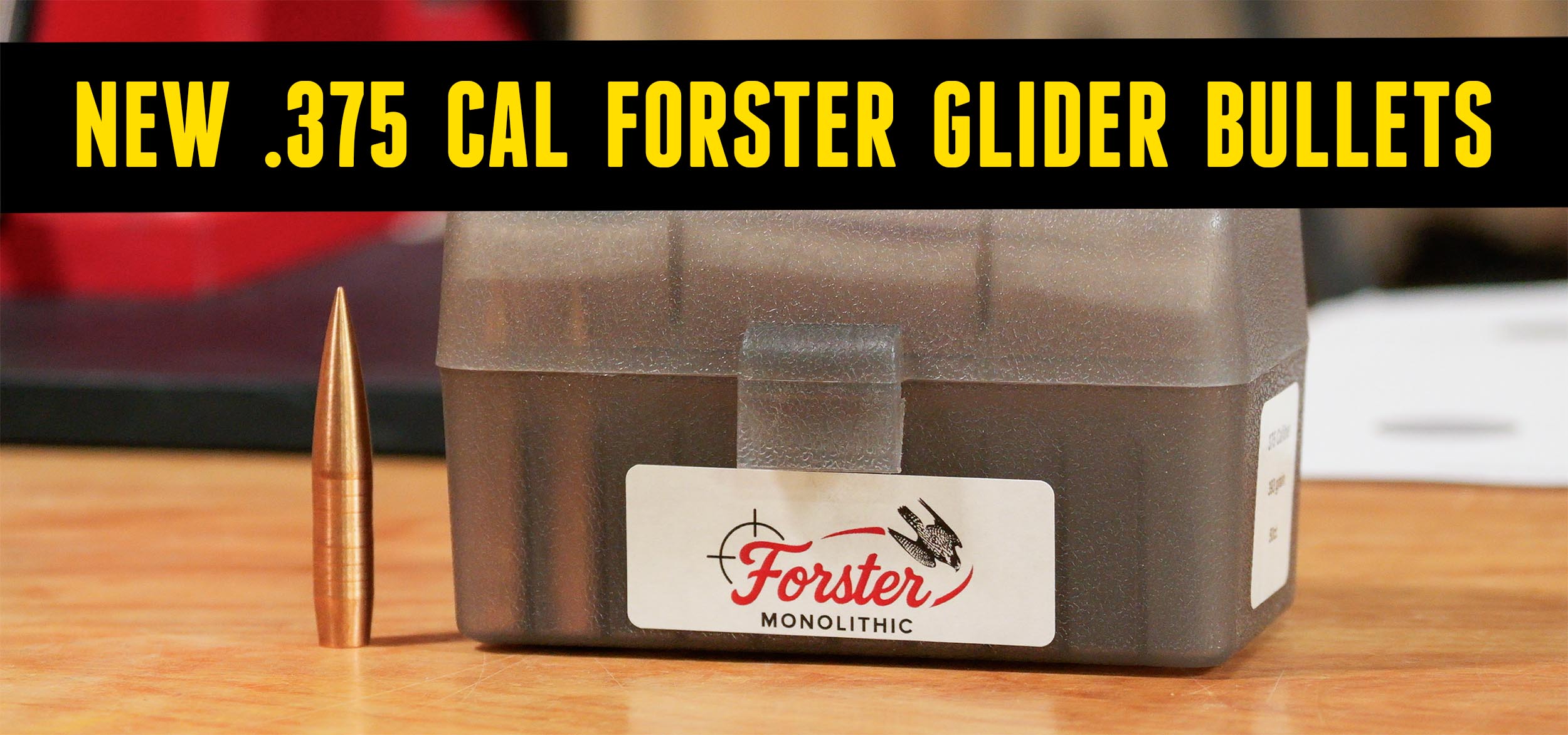
Forster just released a line of bullets for ELR target shooting called Glider. In this article, we’re taking our big, bad 375 CheyTac rifle, doing some load development with the 393 grain Glider, and pushing it out to a mile. This is going to be awesome. Watch or read on!
Disclaimer
Ultimate Reloader LLC / Making with Metal Disclaimer: (by reading this article and/or watching video content you accept these terms). The content on this website (including videos, articles, ammunition reloading data, technical articles, gunsmithing and other information) is for demonstration purposes only. Do not attempt any of the processes or procedures shown or described on this website. All gunsmithing procedures should be carried out by a qualified and licensed gunsmith at their own risk. Do not attempt to repair or modify any firearms based on information on this website. Articles on this website are derived from original video content and may utilize artificial intelligence (AI) tools for initial drafting, transcript processing, and editorial refinement; no AI technology independently generates or verifies technical instructions or safety data. Ultimate Reloader, LLC and Making With Metal can not be held liable for property or personal damage due to viewers/readers of this website performing activities, procedures, techniques, or practices described in whole or part on this website. By accepting these terms, you agree that you alone are solely responsible for your own safety and property as it pertains to activities, procedures, techniques, or practices described in whole or part on this website.
The Rifle
This is the most extreme rifle I’ve ever built here on the channel, and we’ve got a bunch of great content covering both 50 BMG and 375 CheyTac. It’s an ELR rifle built on a BAT EX action, a comically large action meant for 50 BMG and similar cartridges. Here’s the rundown:
- Action: BAT EX
- Chassis: Accurate Rifle Systems, with custom Cerakote and laser imaging (including the flag), which we covered in its own video
- Barrel: Bartlein, chambered in 375 CheyTac, gain twist from 1:8.5 to 1:7.5
- Bipod stabilizer: [VERIFY: BipodExt] bipod stabilizer
- Scope: Leupold Mark 5HD 5-25×56
This thing is an absolute tank, and let me tell you, it can shoot. In fact, we pushed 375 CheyTac all the way to two miles with 400 grain solid copper monolithic bullets. That’s a video you’re definitely going to want to check out.
Forster Bullets: Plainsmaster and Glider
Forster actually has two new bullet lines. Plainsmaster bullets are monolithic copper long-range hunting bullets, and Glider bullets are ELR-oriented long-range monolithic bullets.
Plainsmaster
- 6.5mm: 124 grain
- 7mm: 150 and 161 grain
- 30 caliber: 150, 167, 183 and 203 grain
Glider
- 30 caliber: 216 grain
- 338 caliber: 290 and 305 grain
- 375 caliber: 385, 393 and 420 grain
- 416 caliber: 550 grain
In this feature, we’re specifically covering the 393 grain Glider. This is a monster bullet with a G7 BC of 0.490, so I thought we had to take it to a mile.
Load Development
Equipment
- Forster full-length sizer for 375 CheyTac
- Forster Ultra Micrometer Seater
- Forster Co-Ax XL press
- Peterson 375 CheyTac brass
- Hodgdon H50BMG powder
Just check out the sheer size of that seater die! The Co-Ax XL is Forster’s larger press for ELR-type cartridges. Our cartridge overall length ended up at 4.709 inches, so you’ll need almost five inches of press capacity to load 375 CheyTac. Any 50 BMG-oriented press like the Co-Ax XL will have that.
The 375 CheyTac has a much larger bolt face than you might be used to, but the universal jaws on the Co-Ax XL handle it. There’s one side for BMG and a smaller side, which is what we have them rotated to. It’s really nice to have that capability built into the press so we don’t need special shell holders. We’ve loaded both 375 CheyTac and 50 BMG on this press, and we have a great video covering 375 CheyTac loading as part of our Co-Ax XL coverage.
Like we did with the 400 grain projectiles, we’re using H50BMG, which performed really well for our two-mile shoot.
Results
I started at the same charge weight we used with the 400 grain bullets. The 393 is slightly lighter, so I figured that was a good place to start.
| Charge (H50BMG) | Avg. Velocity | SD | Group (3 shots) |
| 142.0 gr | [VERIFY: 3,054.2] fps | 6.9 fps | Not impressive; very slight pressure signs |
| 140.0 gr | 3,030.1 fps | 3.2 fps | Just over 1 inch |
| 138.0 gr | 2,984 fps | 5.5 fps | 0.498 inch |
At 142 grains, that load is hauling. The group, though, I wasn’t super impressed with. Keep in mind, I had just regraded the area where we shoot with the bipod extender and bipod, so there was probably some settling in going on. We also saw some very slight pressure signs at 142, so I went down to 140 grains. Velocity and SD were great, but the group was still just over an inch, and I definitely wasn’t happy with that.
So I went another two grains down to 138, and that’s the one! An average velocity of 2,984 fps, an SD of 5.5 fps, and a 0.498-inch center-to-center three-shot group.
I’m shooting three-shot groups because that’s what Paul Phillips recommended when we worked through this together. Every time you pull the trigger on this rifle, it’s really, really expensive. You’ve got to make sure your equipment is perfect and your load is as good as you can get it before you start, and you hope things come together quickly, which they did here. I double-checked that my scope bases and caps were tightened, just to make sure everything would go as smoothly as possible.
With just three charge weights, we arrived at a sub-half-MOA group with a tight SD of 5.5. I was completely happy with that, so we decided there was no need for more load development. We loaded up 25 rounds and headed to the Ridgeline Range.
Long-Range Testing on the Ridgeline
We had just shot the 300 Norma at 706 yards, and with a 245 grain bullet, it knocked the Flash Bang right off that target. We’ve also shot the T-post at that target in half multiple times and had to replace it recently. There was every likelihood the 375 CheyTac could rock that target right off its hanger, so I decided to go straight to 0.8 miles.
1,390 yards is a really good challenge and a really good distance to confirm at before going to a full mile. The distance between 1,390 and 1,760 yards is actually quite significant, because things get exponentially more difficult the more yards you add.
I knew there was a likelihood I’d be high. When we did our load development, it was about 60 degrees, and when we went up to the Ridgeline to shoot ELR distances, it was more like 80 degrees. Sure enough, the first shot was a little high, but it was absolutely no problem to get multiple follow-up hits at 1,390 on Harold, our rock chuck target. That rocked him!
I knew I was likely to be high at a mile as well. Once we got the rifle set up, I had to add a little dirt under the skis so we could use the rear bag and have our micro-adjust elevation centered up on the target.
Our dope calculated at 13.1, so I dialed down a bit and started at 12.1. That turned out to be a little low, but windage was good. It was very easy to make corrections and redial our elevation, and I was very happy to center-punch the hole in the rock three times in a row, no problem.
At the end of the day, if we were shooting a 36×36-inch target, we probably would have hit with the first shot and would have had absolutely no problem hitting shot after shot. The 375 CheyTac is almost like cheating, and these 393 grain Glider bullets performed absolutely amazing.
Equipment Performance
We used Peterson brass for this test, and I love that Peterson fills in the gaps with specialty ELR cartridges like 375 CheyTac. We used Peterson for both the 375 CheyTac and the 300 Norma shooting we did this week, both out to a mile. It performed really well and was super consistent, as you saw with the SD numbers.
When we toured the Peterson factory (a video you’ll want to check out), we saw how they make and test their brass. I love the Easy Seat coating and precise inside neck diameter sizing, which give you just the right slip fit. Easy Seat makes it easier to seat both bullets and primers.
The scope is the Leupold Mark 5HD 5-25×56, which is very popular in ELR. We didn’t use the Charlie TARAC this time, because we weren’t dialing up that far and absolutely didn’t need it.
Final Thoughts
This load development and long-range shooting process was way more seamless, way quicker and way more pleasant than some of the other exercises I’ve been through in the past. I think that’s what you get when you have the right rifle and the right optic. This rig is awesome. I absolutely love shooting it, and it feels really good to connect with targets at a mile.
Don’t forget, there are both Plainsmaster and Glider bullets with multiple caliber offerings. Whether you’re doing long-range hunting or long-range target shooting, these could be great options for you. We got great results here, and I’m sure you will too.
Of all the bullets I listed, which would be interesting to you for your application, long-range hunting or target work? And what do you think of the Incredible Hulk, this ELR rifle we’ve put together, and the results at a mile? Let me know in the comments!
Get the Gear
Don’t miss out on Ultimate Reloader updates, make sure you’re subscribed!
Thanks,
Gavin Gear
About the author