
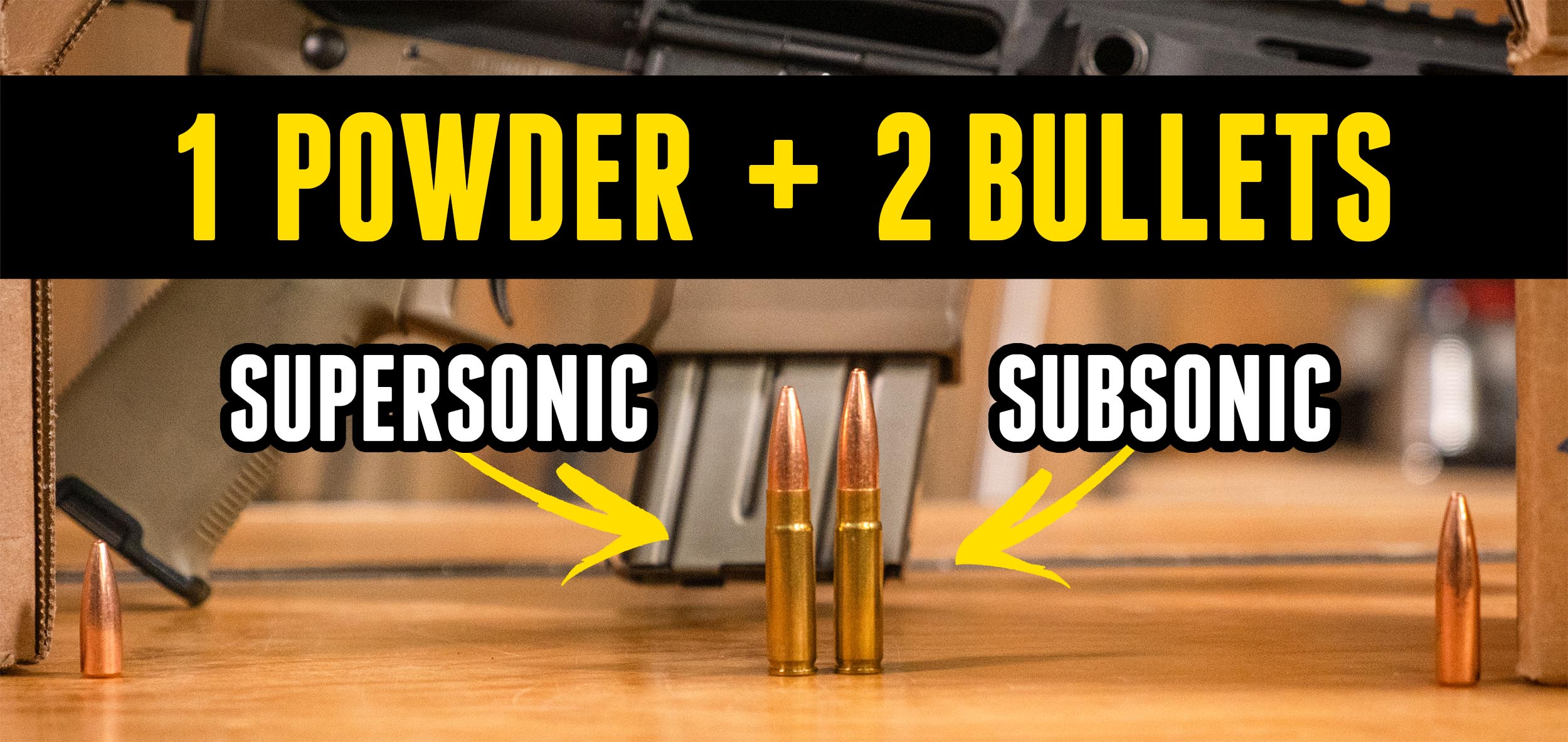
We are back with more .300 Blackout content! This is one of my absolute favorite cartridges and shooting scenarios, and we have done a ton of work with it so far. What if I told you that one powder and two different bullets could cover almost all of your .300 Blackout needs for both subsonic and supersonic applications? In this video, we dive in-depth into a highly efficient and economical reloading strategy utilizing Berry’s Manufacturing bullets and Hodgdon H110 powder.
Disclaimer
Ultimate Reloader LLC / Making with Metal Disclaimer: (by reading this article and/or watching video content you accept these terms). The content on this website (including videos, articles, ammunition reloading data, technical articles, gunsmithing and other information) is for demonstration purposes only. Do not attempt any of the processes or procedures shown or described on this website. All gunsmithing procedures should be carried out by a qualified and licensed gunsmith at their own risk. Do not attempt to repair or modify any firearms based on information on this website. Ultimate Reloader, LLC and Making With Metal can not be held liable for property or personal damage due to viewers/readers of this website performing activities, procedures, techniques, or practices described in whole or part on this website. By accepting these terms, you agree that you alone are solely responsible for your own safety and property as it pertains to activities, procedures, techniques, or practices described in whole or part on this website.
The Subsonic Cost Advantage
Heavy bullets traveling slowly work perfectly for subsonic applications, but if you don’t use the right components, it gets really expensive. Running the numbers through the Ultimate Reloader Cost Calculator, factory 220-grain subsonic ammunition can easily cost $1.30 per round (around $25.99 for a 20-pack).
By utilizing Berry’s 220-grain .30 caliber bullets, our reload costs drop to just $0.37 per round. If you shoot 1,000 rounds of factory ammo, it will cost you nearly $1,300. Loading 1,000 rounds yourself costs about $368. That is a savings of over $930! The long and short of it is: if you shoot a lot of subsonic .300 Blackout, you definitely want to be loading your own ammunition.
The Subsonic Load: 220-Grain
The Berry’s 220-grain bullet is highly cost-effective and designed for the .300 Blackout. It requires a minimum twist rate of 1:10.5″, which makes it perfectly optimal for standard SAAMI spec 1:8″ twist .300 Blackout barrels.
(Note: Do not use this load data blindly; always consult published manuals like Hodgdon’s to ensure safety).
We loaded these 220-grain bullets over 10.74 grains of Hodgdon H110 at a Cartridge Overall Length (COAL) of 2.230″. Fired through an AR-15 with a 16-inch Anderson upper and an Omega 300 suppressor, this yielded an average velocity of 1,029.1 fps. This is right in the optimal 1,000 to 1,050 fps window, keeping us safely away from the transonic threshold (around 1,080 fps) so we avoid any supersonic cracks.
The Supersonic Load: 150-Grain Spire Point
To unlock the ballistic and tactical versatility of the .300 Blackout, we introduced a brand new bullet: the Berry’s 150-grain Spire Point. While Berry’s makes flat-point 150-grain bullets for the .30-30 Winchester, those will not feed reliably out of AR-15 magazines. This new Spire Point feeds incredibly well.
For this supersonic load, we stayed with the same powder, using 13.75 grains of H110 loaded to a COAL of 2.100″. This resulted in an average velocity of 1,511.4 fps with an excellent Standard Deviation (SD) of 14.3.
While Berry’s rates this bullet for up to 1,650 fps in a 1:7″ twist barrel, I preferred the performance and tight SD we achieved at 1,511 fps, keeping us well within conservative safety margins.
The Setup and Energy Comparison
For high-volume cartridges like .300 Blackout, I prefer using a progressive press. I utilized the Hornady Lock-N-Load AP, equipping it with two dedicated seating dies—one marked for the 220-grain and one for the 150-grain. This allowed for incredibly fast changeovers. I also used a micrometer on the powder measure, noting my exact settings so I could switch between the 10.74-grain and 13.75-grain charges effortlessly.
How does the energy compare between the two? Kinetic energy heavily favors velocity (Energy = 1/2 mass x velocity squared).
- 220-Grain Subsonic: 1,029 fps yields 517.6 foot-pounds of energy.
- 150-Grain Supersonic: 1,511 fps yields 761.0 foot-pounds of energy.
The lighter, faster load delivers almost 50% more kinetic energy, making it the practical choice for hunting applications like shooting rock chucks. The 220-grain load, however, remains the undisputed king for quiet, suppressor-friendly target shooting without the need for hearing protection.
Conclusion
We successfully found a highly efficient system: one powder (H110) paired with two Berry’s bullets (150gr and 220gr) using a fast-swapping progressive press setup. It cuts factory ammunition costs in half while providing the flexibility to tune loads precisely to your specific firearm—whether you are running a 5-inch pistol build or a full 16-inch rifle.
Get the Gear
Berry’s 300 AAC .308 220 Grain Blackout Spire Point Bullets at Midsouth Shooters Supply
308 150 Grain | Bullets for Reloading | Bulk Bullets (berrysmfg.com)
Don’t miss out on Ultimate Reloader updates, make sure you’re subscribed!
Thanks,
Gavin Gear
About the author