
When setting up a professional Cerakote shop, choosing the right curing oven is just as critical as selecting your spray booth. Different coatings require specific temperature holds and dwell times, and your equipment needs to accommodate your largest parts while maintaining even convection heating. In this buyer’s guide, we’ll break down curing requirements, sizing guidelines, oven models, and essential accessories.
Disclaimer
Ultimate Reloader LLC / Making with Metal Disclaimer: (by reading this article and/or watching video content you accept these terms). The content on this website (including videos, articles, ammunition reloading data, technical articles, gunsmithing and other information) is for demonstration purposes only. Do not attempt any of the processes or procedures shown or described on this website. All gunsmithing procedures should be carried out by a qualified and licensed gunsmith at their own risk. Do not attempt to repair or modify any firearms based on information on this website. Articles on this website are derived from original video content and may utilize artificial intelligence (AI) tools for initial drafting, transcript processing, and editorial refinement; no AI technology independently generates or verifies technical instructions or safety data. Ultimate Reloader, LLC and Making With Metal can not be held liable for property or personal damage due to viewers/readers of this website performing activities, procedures, techniques, or practices described in whole or part on this website. By accepting these terms, you agree that you alone are solely responsible for your own safety and property as it pertains to activities, procedures, techniques, or practices described in whole or part on this website.
Cerakote Curing Requirements
Before looking at hardware, it helps to understand what temperature and time profiles your oven needs to support:
- H-Series: Typically cures at 250°F for 2 hours (or 150°F–180°F for 2 hours when coating polymers or scopes).
- E-Series: Requires roughly 300°F for 1 hour (or 150°F–180°F for 2 hours on polymers/optics).
- F-Series (Fast Cure): A newer formulation that cures at 250°F in just 15 minutes (or 180°F for 1 hour on polymers).
- C-Series: Air-cured, so no oven required.
While most coatings cure between 150°F and 300°F, professional ovens like those from Built American easily reach 500°F to 550°F, giving you plenty of thermal headroom.
Sizing Your Oven
When determining oven size, the golden rule is: take your longest part, add clearance for hanging hooks at the top, and ensure enough room for easy insertion and removal.
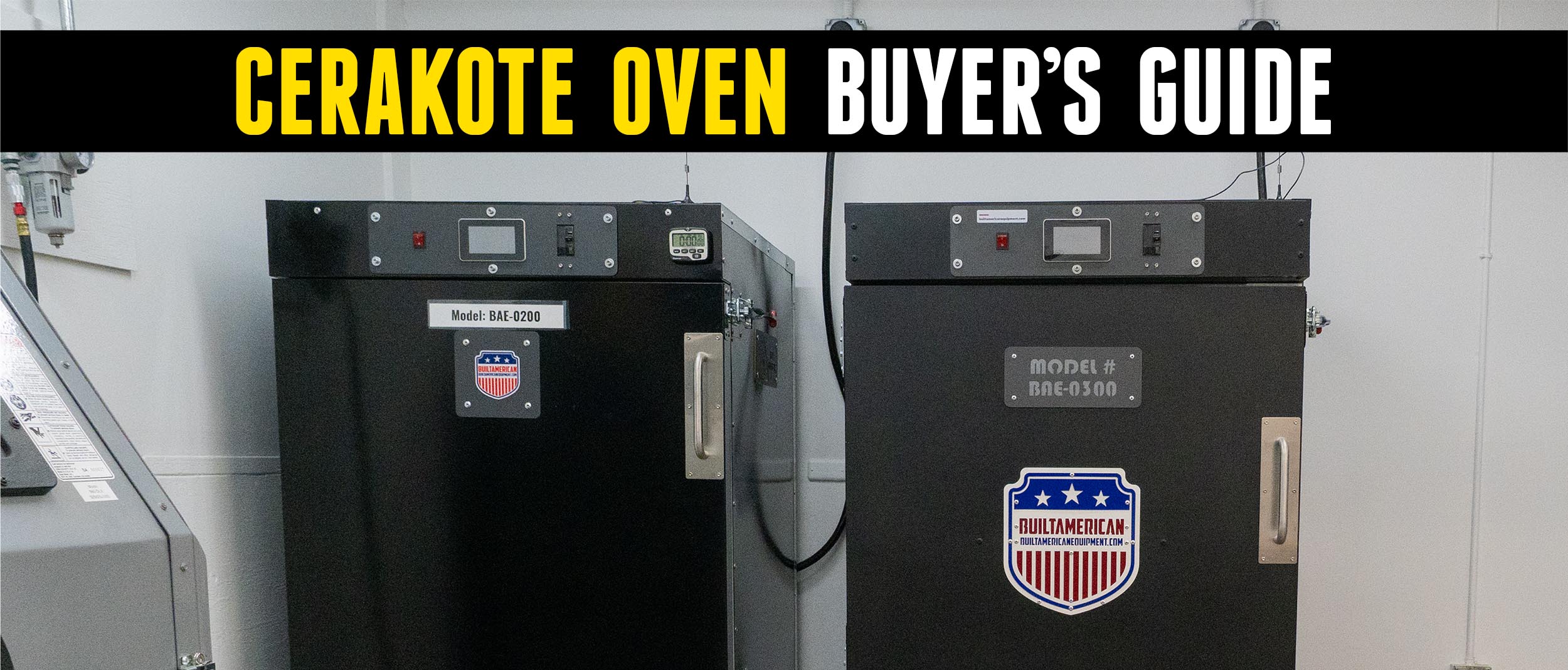
- Vertical Height: A complete rifle measures about 44 inches long, while individual barrels, actions, and chassis typically run 24 to 30 inches. If you are doing rifle work, aim for an interior height of at least 58 inches (such as Built American’s BAE0200 or BAE0300 models).
- Width and Depth: Consider whether you are hanging parts individually or utilizing roll-in carts for batch processing (which can dramatically multiply your shop’s throughput).
Built American offers several industry-standard models:
- BAE0100: A smaller unit (24″ x 24″ x 48″ interior) drawing 240V / 20A. Ideal for handguns, optics, and smaller automotive or medical parts.
- BAE0200 & BAE0300: Larger production ovens featuring 58-inch interior heights, weighing around 800 lbs each. The BAE0300 is specifically optimized for roll-in cart workflows.
- CRCO500: Custom industrial-scale production units built for firearms OEMs.
Key Features to Look For
If you are running a commercial shop rather than taking on a DIY project, investing in a pre-built industrial oven saves dozens of hours of fabrication and delivers superior performance:
- Covered Heating Elements: Bare elements radiate direct radiant heat, which can cause uneven curing. Covered elements ensure that heat transfer is driven by convection (bulk air circulation via a fan), maintaining uniform temperatures throughout the chamber.
- Circulation Fan: Essential for keeping temperatures consistent from top to bottom.
- Heavy-Duty Insulation and Seals: Industrial-grade insulation keeps heat inside the oven, reducing energy costs and preventing your shop from overheating during summer months.
- Wi-Fi Touchscreen Controls: Allows you to program ramp-up/ramp-down times and temperatures easily, with automatic shut-off upon cycle completion and remote monitoring capabilities.
- Upgraded Interiors & Casters: Stainless steel interior chambers resist corrosion and last a lifetime, while leveling casters make positioning the heavy units effortless.
Conclusion
When shopping for a Cerakote oven, spec for your tallest parts and plan your electrical requirements (most professional units require a dedicated 240V circuit). Buying a proven, commercial-grade oven allows you to focus on coating parts and driving shop revenue rather than troubleshooting DIY builds.
What questions do you have about choosing a Cerakote oven or setting up your shop’s workflow? Drop a comment below!
Get the Gear

Don’t miss out on Ultimate Reloader updates, make sure you’re subscribed!
Thanks,
Gavin Gear
About the author