One important thing to consider when contemplating a bullet feed system is – “How am I going to setup my dies and powder measure, and do I really have room and enough stations to make this thing work?”. Well, those are good questions, and this post will discuss a few different die configurations on the Hornady Lock-N-Load AP when using the Hornady Lock-N-Load Bullet Feeder.
Five stations may sound like a lot when you first get your press, but as you setup dies, change calibers, add powder check stations and so on – you’ll realize that in some cases more stations would actually be better! So, there are compromises to make.
Ideally, if we dream for a moment, and consider all of the possibilities for progressive loading of rifle and pistol calibers, one could arrive at something like the following for die stations and operations on a progressive reloading press:
Ideal dedicated station die placement:
Station 1: Size/Deprime
Station 2: Expander
Station 3: Powder Charge
Station 4: Powder Check
Station 5: Bullet Feed
Station 6: Bullet Seat
Station 7: Bullet Crimp
Yes, 7 stations would be nice, but most progressive presses have only 4 or 5 stations (The Hornady Lock-N-Load AP has 5), and most people would not be able to rationalize a press with more than 5 stations from a cost standpoint (think of the caliber conversion parts!). In reality, 5 station presses work quite well, and are cost effective. Just spend some time on a press with less than 5 stations, and you’ll know what I’m talking about…
So, having said all that- what would the typical die setups look like for a complete Lock-N-Load AP press with case feeder and bullet feeder? Here are the top three die setups that I’ve come up with and their corresponding tradeoffs.
Option 1: Powder Check Enabled (Recommended)
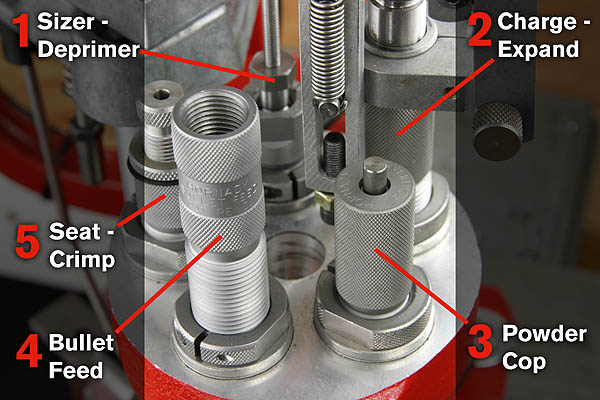
The reason I recommend this die placement is that when you have both a case feed system and bullet feed system in place, you’ll inevitably start loading much more quickly. When you’re moving faster, you tend to spend less time performing tasks such as inspecting and validating the powder charge visually. This means more of a chance of either a squib (empty) load, or a double charge. You could also use other powder check systems such as the RCBS Lock-Out Die in this station just as easily.
Benefit: Safety
Cost: No separate seat/crimp capability (combined in station 5)
Option 2: Separate Seat/Crimp
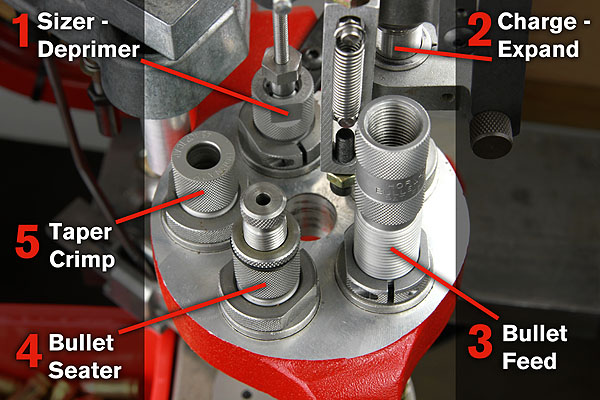
Here we see what it looks like to have separate seat and crimp stations when using the Hornady Lock-N-Load Bullet Feeder. This is a popular setup, but is not as safe as when using a powder check die.
Benefit: Seating Precision, No lead shaving, Isolated die setups for seat and crimp
Cost: No powder check (not as safe – must be vigilant about visual powder level inspection!)
Option 3: Separate Expander and Powder Charge
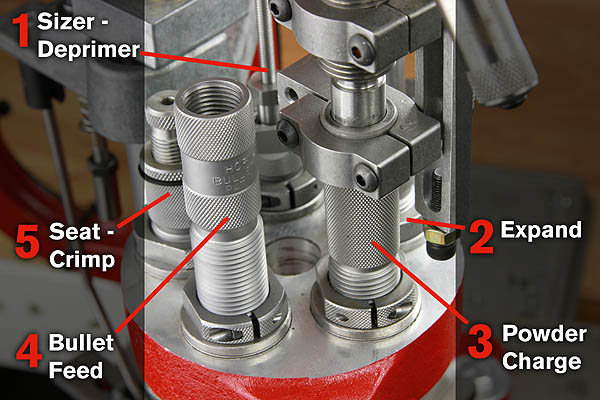
Finally, we see the setup when using separate expander and powder charge stations. This negates the need for using PTX expanders (and buying the powder die bodies if you want quick changeovers) but like the separate seat/crimp setup does not allow the user of a powder check die.
Benefit: Simplified Powder measure Setup
Cost: No powder check (not as safe – must be vigilant about visual powder level inspection!)
While I’m sure folks will come up with other options, these are the primary setups that I’ve experimented with, and I feel they represent the “mainstream” options that one would be likely to use. For me, I’ll stick with the powder check enabled option because of the safety factor. The new PTX expander bracket and enhanced design of the PTX expander profile (launched with bullet feed dies) makes for both easy setups and consistent/reliable case mouth expansion. When you have reliable case mouth expansion, you have more consistent automated bullet feed action.
Now, we’ve covered most of the basics for the Hornady Lock-N-Load bullet feed system. Next, let’s see this system in action! Sounds like it’s time for some HD videos 🙂
Do you have other die setups that you’ve employed with this system? Please share by commenting on this post!
Thanks,
Gavin

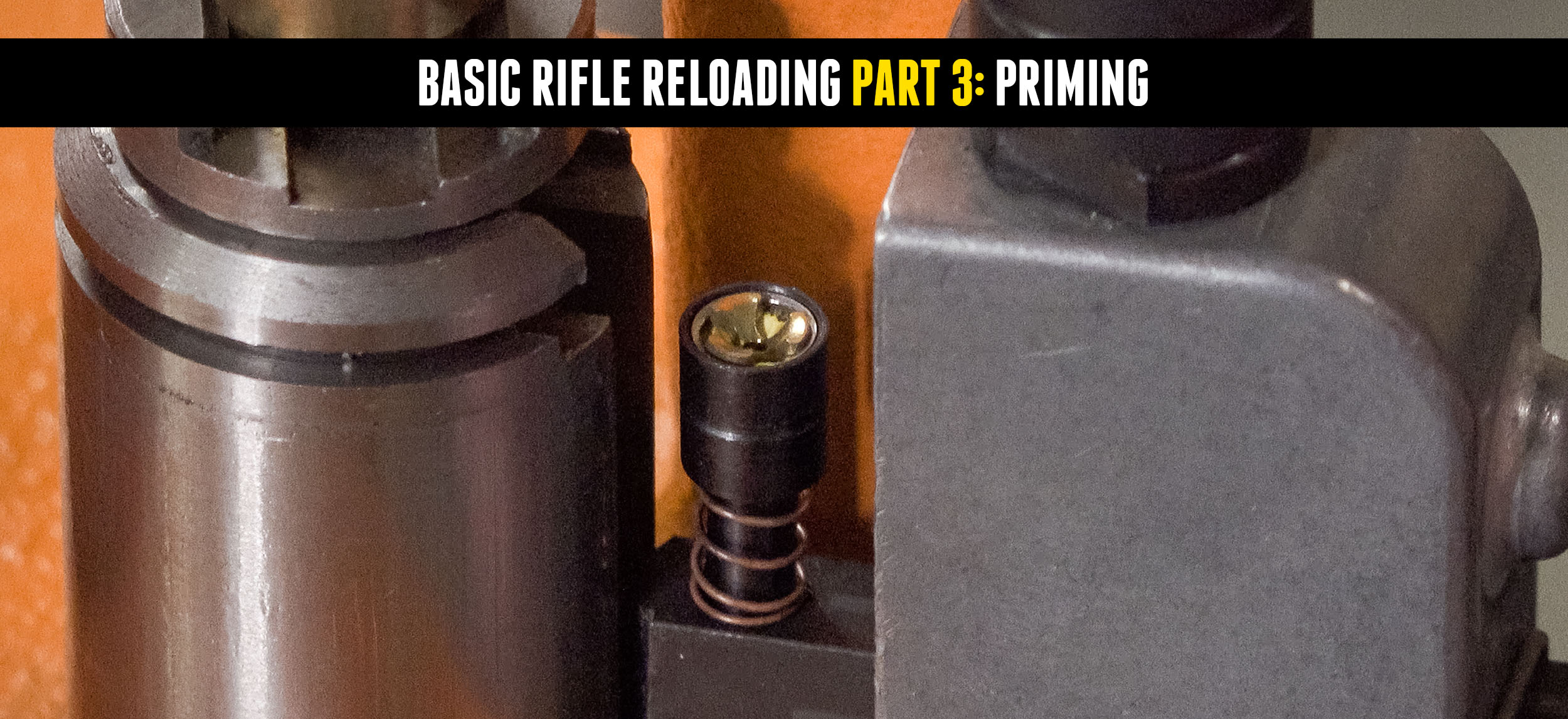

















































Where does the primer get set at in these photos???
After sizing it gets pressed in on the down-stroke just before the upstroke in station #2. (priming station is below the die in station #2). Priming at the bottom of the stroke is best because you can “feel” the priming force due to the fact that no other die operations are happening at the same time (like you would have if you were priming at the top of the stroke).
Gavin:
You reference: “The new PTX expander bracket and enhanced design of the PTX expander profile (launched with bullet feed dies)”, and the new bracket is evident in your photos, but tell us more about this.
How does this new bracket improve the product, and where can this bracket be purchased? I haven’t seen any reference to it anywhere before.
Thanks.
Great point- I don’t think it’s well documented. I’ll make a note to cover this in my videos/posts for this bullet feeder. I know there’s been a lot of talk online about the old PTX expander design (some people have had trouble flaring enough…)
I’m not new to reloading, but am just setting up my LNL AP that came for Christmas. I am having some trouble with primer seating. About 10% of my finished work looks great but is missing a primer. based on the feel of the downstroke, I believe I am seating a primer, but it’s not there some of the time. I am loading once fired cases of mixed headstamp. Maybe you can cover this as well, and also maybe some adjusting hints for the press..not dies as much as timing and pawls.
A couple things to look at:
1. Make sure the primer tube aligns with the primer slide hole at the backwards extreme of the primer slide stroke?
2. Have you ever seen the primer slide stick in the rear-most position?
3. What caliber and brand of primers are you using? (may try different primers, but I haven’t had many priming issues on the LNL)
I called Hornady when I was setting up my bullet feeder and asked them about the bracket. They said it was packaged with the new L-N-L AP presses. I told them that my press was one of the first with the ezject system. Hornady sent me a PTX bracket free of charge and I recieved it in about 3 business days. The PTX bracket stops the force on the powder measure when the arm is at the top of the cycle but allows you to fully control the case mouth expansion.
That’s good customer service. Has it worked out for you? (have you tried it yet?)
Yes, the PTX adapter works great! Also the bullet feeder with the 40 S&W die worked flawlessly. You can make very small adjustments with the PTX adapter to the flare for optimum performance with the bullet feeder. Use Less flare for beveled base bullets and more flare for flat base bullets. You want to get the flare adjusted so the bullet feeder die sticks the bullet in tight enough so it wont tip during the shell plate rotation. I have loaded 1100 rounds of plated bullets (flat base 155gr and beveled 165gr with no miss feeds. I am waiting patiently for my 9mm and 45 ACP dies.
Do you have a part # I could reference? I called Hornady and the person on the Sales desk had problems identifying the bracket component.
FYI. Hornady PTX powder funnel bracket part # is 290049. Cost is $7.80.
Couldn’t talk my way into a free part.
Chris when I called I was having as small problem with the bullet feeder bowl setup so I spoke to technical support person and not sales person. I just mentioned to him that I already had the PTX expander inserts but quit using them because it put too much stress on the powder measure. He told me that the PTX attachment solved that problem and offered to send me one. I could not turn down a free offer. I guess it comes down to who you get when you call.
You can use this device to monitor your actions on the press and still have some security with your loads while using option 2 or 3.
http://www.pressmonitordevice.com/
How does the press monitor “add security” when it doesn’t measure powder level…from what I can tell, all it can add to a LnL AP is statistical measurements for rounds/hr etc.
Please explain how this compensates for a lack of powder cop/lockout die?
I do not have this piece of equipment but I hope to get it in the near futur. So from what I read it monitors your stroke, so it will detect if you have not depressed or raised the lever to the maximum it should go. They say this on their site: Alerts the user when a mistake is made such as short stroking the press, forgetting to rotate the shellplate on a manual indexing press, or any other action out of sequence. This can prevent a double charge, squib, or light charge round. By the way I have nothing to do with them, I just read what their site says.
Gavin, I just watched your video setting up the Hornady LNL Bullet Feeder to load 45 ACP. My question is “Why do you use the powder cop and then have the seat and crimp functions performed together?”
Personally, I have had just about zero problems loading this cartridge on Dillon equipment and have developed a tremendous level of confidence in their PM. I have not heard that the Hornady PM is any less precise and reliable. Thus, I am less than enthusiastic about having a powder check/powder cop die use up a station vs having a separate seat and crimp operation.
Dave in MA
I just ordered my LnL AP today. I am looking for the dies in your option 1 setup and a part number/item number list would be helpfull.
I got my LNL today I found the hornady powder cop die on midway usa #199393 they did not have the bullets drop die , you can try wed site it 10ring.com just call first to see if they have it or you will have to wait for them to get it in, and then they will mail it to you there prices where pretty good on some thing.Oh on my hornady LNL all of the primers tubes were missing from the box but i call hornady up and there going to send me all the parts i need .hope you find your dies
Gavin can you tell me on the hornady lnl ,the powder charge station do you have to somethig for Dif. cal like 9mm to 40 to 45 acp or will the powder charge system work for all cal. like the lee uses a dif. powder thru die for 9 ,40 and 45 ,and so on . i was looking on hornady web site and can not find any thing .I thank you any you can give me ,mark
I’m using the recommended layout, with the case and bullet feeder, along with the expander/powder funnel. The problem I’m having is that the hornady crimp/bullet seater is not crimping tight enough and the bullet is loose in the case. If I go down any tighter, the case buckles. Hornady says I need to take out the powder check (i use the RCB lock out) and add a separate taper crimp station after the bullet set station. I have a Lee die I can use for this, but hate to lose the powder check.
The 1150 is looking more attractive with all its stations.
Thoughts?
Rl 1100 or s1050. If you got that kind of money look at mark 7 evolution. All cnc vs cast dillon parts.
I have just ordered dillon 1050. Do I loose a die station if i get the Hornady lnl bf?
Yes, you do loose a station, but with 7 stations available, you should be fine (I don’t have a 1050 yet, so I don’t know the exact details…)
I don’t have the bullet feeder yet, but here is what I am thinking about doing when I get it. I am going to run each piece of brass through twice. The first pass will resize and prime. Once I get a thousand or so cases primed I will use this set up to finish off.
1) Powder, expand
2) RCBS Lock out die
3) Bullet feeder
4) Seat
5) Crimp
I don’t want to run everything twice, but that second pass will have everything I want, plus I won’t have to stop to restock primers.
(Just wanted to put in a pointer to the comment on Dec. 15th from Randy, as it references this post.)
I have considered this too for loading .45 ACP. I have been getting into the habit of de-capping my brass first before cleaning so I can get a nice clean primer pocket. I have been using a universal de-capping die to do this. I really don’t want to re-size dirty brass so I will probably end up running my brass through 3 times….
A 1-Decap (and then clean)
B 1-re-size 2-expand
c 1-Charge 2-Cop 3-feed 4-seat 5-crimp
I am looking at getting the LNL and also getting the case feeder and bullet feeder with it. This will be my first press and my first experience reloading. I am mainly going to reload 40 for now until I get the hang of it.
I would like to use the first setup with the cop die. I need help as far as what to buy for the dies though, to get the multiple stations.
Branden- here’s what you’ll need:
– 40/10mm Hornady die set (3-die set, sizer/deprimer, expander, seat/crimp)
– 40/10mm pistol bullet feed die (die and PTX expander)
– Hornady powder cop die
Have fun with it!
Super thanks!
Also forgot to ask witch manuals you recommend and also which primers for reloading 40 S&W?
Thanks
Most of the manuals are pretty good. The Hornady manual has complete listings, including COL for the loads listed – I find that handy for pistol data. You can also get load data from the powder manufacturer sites online.
For primers, you’ll need small pistol primers (standard). I have recently taken a liking to Wolf primers because when you carefully remove the cardboard sleeve and lift the plastic tray, the primers are all properly oriented (and spaced!) for quick use of the pickup tube. 🙂 Winchester small pistol primers are good, as are CCI, and others.
Gavin,
First THANKS a ton for all the info. I like the setup Jeff described on July 11. What would be your comment? Is it to many pulls?
I just starting this project and will look to get your ARM. you need to Market your stand as well 🙂
Also curious about what Jeff is proposing. I think you can even have an expander die on the first pass, so that the powder station (on the second pass) is not also doing expansion. That’s equivalent to your ideal 7-station set-up Gavin proposes at the beginning of the article.
Three related questions:
1. This proposed set-up assumes that the powder station can be inserted in station #1. Is there a clearance issue there?
2. It also assumes that the primer can be disabled on the second pass, as the case is already re-primed in the first pass.
3. It also assumes that the flared case will feed fine through the case feeder on the second pass, and that it is safe to use with re-primed cases.
Very interested in learning the answer to BL’s question #1 above!
As for #2, I know that the primer punch is removable if there is a problem with running primed cases thru the system with an empty primer tube.
If #3 is a problem you can just expand while charging.
I love the idea of the powder cop and I love this website too Gavin! You’re a fine teacher, especially for such a young guy.
My idea is to use a De-capper/expander die in a single stage press, clean my brass then set up my LNL with the charge/expand in station 1, powder cop in station 2, bullet feed in station 3, seat in station 4, and taper crimp in station 5
I like cleaning my brass (including checking and possibly clearing/deburring the flash hole) before reloading
Keep up the awesome work!
I am using Option 1 in my setup but I find myself having a bit of trouble fitting the powder drop in station 2. There is a lot of hardware on it and no mater what position I put it in, it rubs or is blocked by the case feeder tube, the decapping pin, the primer tube, or the powder cop…
Bill,
Don’t know if you’ve figured out your clearance issue yet… but if you watch Gavin’s videos on loading 9mm in the LnL AP you will see him use the Powder Drop in Station 2 with a PTX. You might get some ideas on orientation there to help you get loading.
Hi, I have the number one setup that’s recommended. At station two when expanding with the PTX die it sticks where I have to thump the handle to release the expanding PTX from the brass. I don’t like this. I talked to Hornady and they think it will stop as I use the press more. Have you ever encountered this? I prefer it to be smooth. Thanks
Best regards,
Mark
Gavin,
Thank you so much for all your work on this website. The quality and depth of your presentation has been a Godsend.
I have been reloading on a Hornady LNL progressive with case and bullet feeder for a while and I just ran into a snag. I loaded about 400 9mm Blazer cases without a problem and as I switched to the Winchester cases with the same 124gn FMJRN bullet they fell every time after being set by the feeder die. My press is very firmly set on a heavy bench. I started setting the PTX expander a bit deeper and wider but I started being afraid of weakening the brass. I finished realoading the next 400 rounds holding the bullets in place which isn’t so bad but I would love to solve this problem.
Thank you for your wisdom as for the others who might have a hint.
Galvin, I am looking to get a LNL AP and I like the set up in opt 1, to load pistol in 40 s&w , 9mm and 45 acp in rifle 223, 308, 6.8spc and 7.62×39 . I am assuming opt 1 is aval in the calibers listed in both pistol and rifle or would it have to be set to a different configuration ?
Also does Hornady have a component list for dies ?
I have found your site to be very helpful and helped in making my decision to start to reload as well as too which loader to go for
Thanks again.
I have put a buzzer on the powder cop and one on the primer to let me know how many primers are left. Works good. I think Hornady has some also but mine only cost $8.00
Bill
I have been using the LnL for years now Without a bullet feeder. But I swear I saw a die come out to feed AND seat in one station. The feed tube entered the side of the die. I called Hornady and they told me they do not know of one. ? Has anyone else seen or heard of this die?
Maybe I was dreaming? Or having a flashback?
Gavin,
I am using the Hornady AP press with option 1 die set up. My problem is after the bullet 38 Special plated DEWC enters the 5th station it, slants slightly forward towards the center of the press, and will not enter the seating and crimping die, without me pushing on the spring to straighten up the round.
I have talked to tech support at Hornady and they have given me different
ideas? The last on being the 5th station is for crimping and not bullet seating.
This works fine however I lose my powder cop and this I am not happy about.
Any other options would be appreciated – Thanks Ed
Just ordered the press! I am planning on loading my own cases and bullets by hand. I don’t need to go that fast. I am windering if it makes sense and if there are quality dies for the following setup (at least for .233):
1: size / deprime
2. Expand / charge
3. Powder cop
4. Bullet seat
5. Bullet crimp
I don’t know where to look for the dies to compliment this separate seating and crimping setup. Thanks!
Hey Gavin,
I’ve ordered the Hornady LNL. Plan is to go slow as I learn (starting on .223) and place cases and bullets by hand. I want to use a powder cop, and use separate seat and crimp dies. Please let me know how this setup sounds:
1. Size / deprime
2. Expand / charge
3. Powder cop
4. Seat
5. Crimp
My question is which dies to get for this setup. Obviously a 3-die kit will be necessary, and also wondering if I need a caliber specific charge die for expanding the case neck. That stage seems to get glossed over a lot in videos and writeups I’ve seen. Thanks!
Cool! I would say to keep it simple. You won’t need to expand bottleneck rifle cartridges like .223.
Here’s my simple setup (how I would start):
1. Size/de-prime
2. Empty
3. Powder charge
4. Seat bullet
5. Empty
If you are using cannelured bullets (with the indentation marks for a crimp groove) then you could put a seating die in station 5, or use a seater that also crimps.